
In-pack promotional gifts give beverage brands an opportunity to offer customers something beyond the product they originally intended to buy. A branded beer glass, for example, can become part of the drinking experience while keeping the brand visible after the beverage has been consumed.
However, a successful promotion requires more than selecting an attractive giveaway. The gift must fit the retail pack, remain protected during distribution and make commercial sense at the planned production volume.
A Guinness beer glass promotion previously spotted in Hong Kong provides a useful example of how product design and packaging can work together.
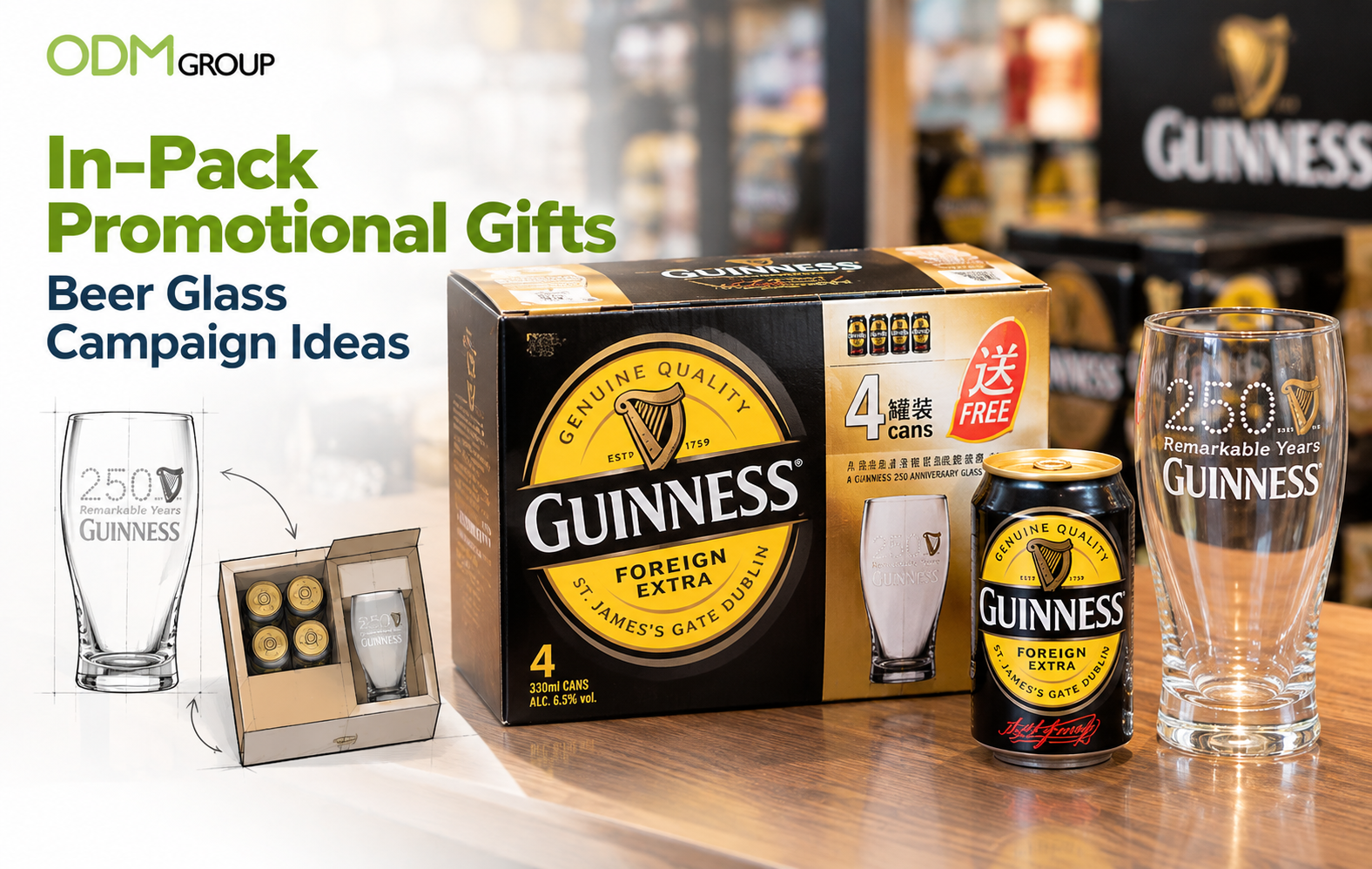
Guinness Beer Glass Promotion: A Retail Example
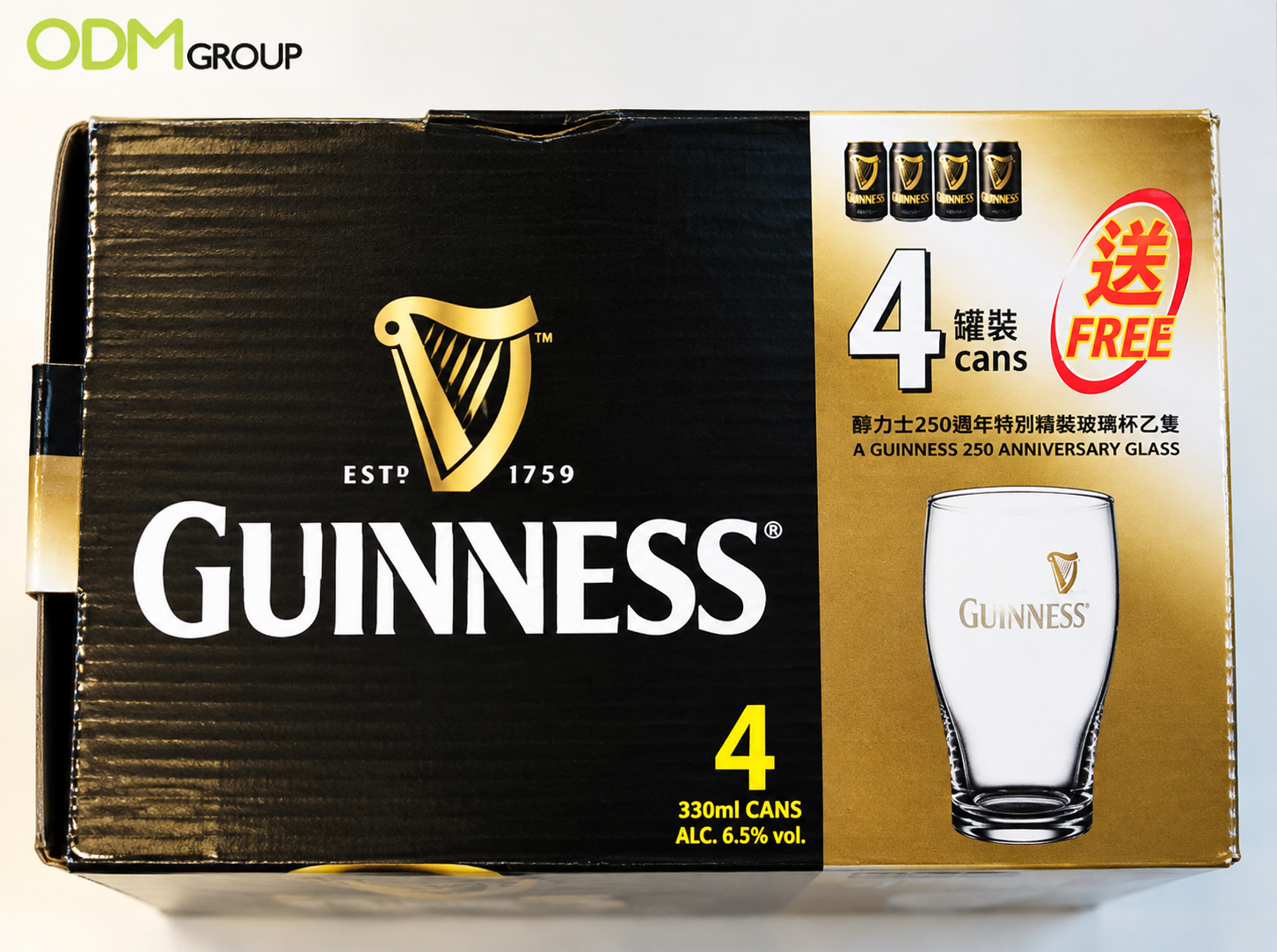
In a campaign documented by ODM Group in 2014, Guinness offered a traditional contoured beer glass with a four-pack of 330 ml cans sold in Hong Kong supermarkets.
The original retail observation recorded a promotional pack price of HK$36.50. This was a historical price, not a current retail offer.
The branded glass featured a contoured shape, a screen-printed logo and sufficient capacity to hold one can of beer.
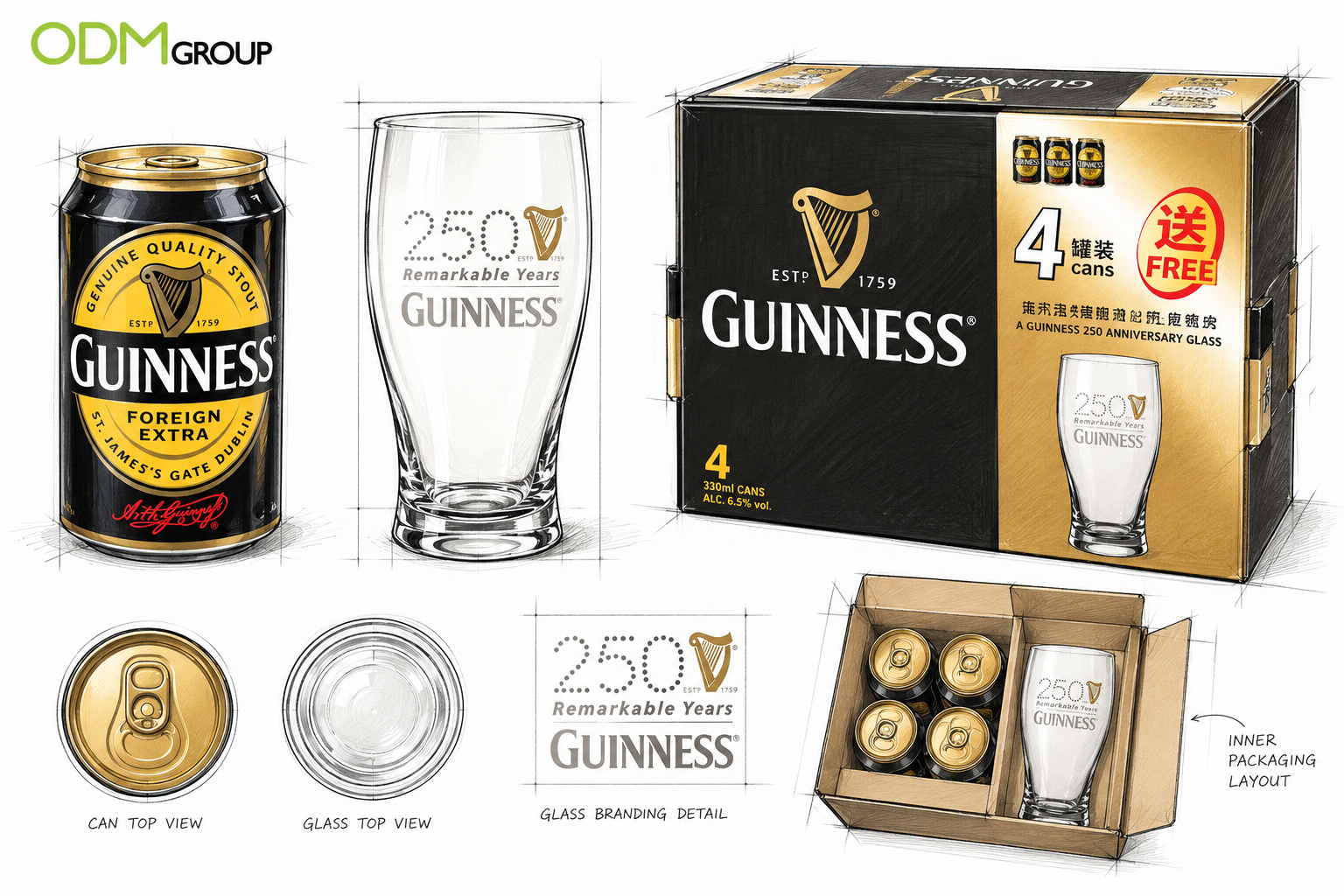
The packaging was equally important. Four cans and the promotional glass were arranged inside a cardboard outer box, with the glass held in a separate protective compartment.
This arrangement allowed the retailer to offer the beverage and gift together as one purchase.
The campaign also illustrates the potential of collectible merchandise. Offering one glass per pack could encourage customers who wanted a matching set to purchase additional packs, although the original case study does not establish whether repeat purchases increased.
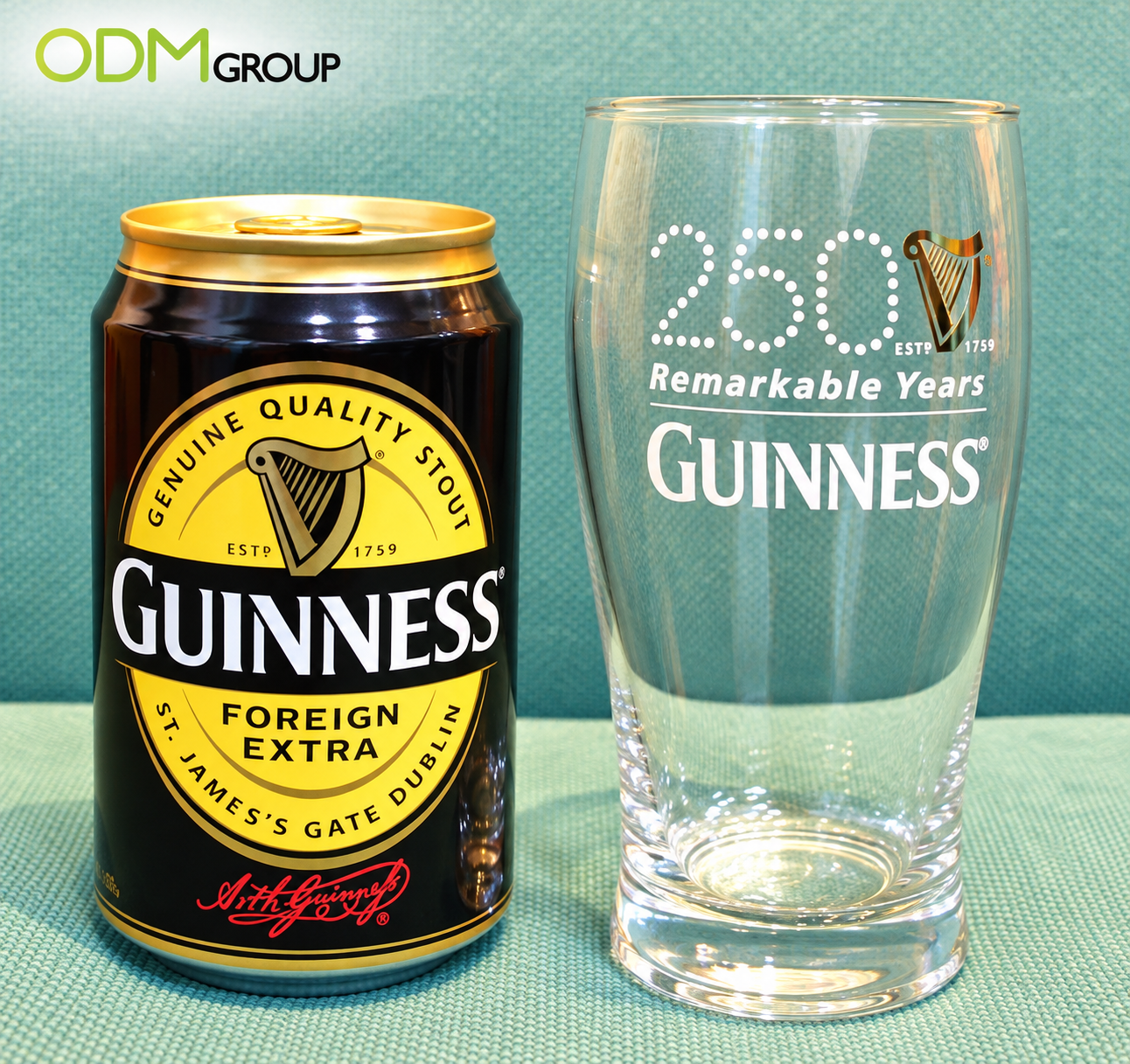
Caption: Historical Guinness in-pack promotion featuring a branded beer glass with a four-can pack in Hong Kong.
Why Do In-Pack Promotional Gifts Work for Beverage Brands?
An in-pack promotion places the incentive directly alongside the product being purchased.
Unlike a separate redemption programme, customers can see what is included in the promotional offer before making a purchase.
For beverage brands, relevant promotional gifts may help support several campaign objectives.
Add Value at the Point of Purchase
A useful gift can give shoppers an additional reason to consider a promotional pack, particularly when competing products have similar pricing or positioning.
The incentive should still be proportionate to the product and target audience. An expensive gift that significantly increases the retail price may undermine the offer.
Extend Brand Visibility Beyond Consumption
A branded glass can remain in use after the original beverage has been consumed.
Its practical value makes it different from a temporary discount or disposable promotional item. However, long-term use depends on the quality, design and relevance of the gift.
Support Seasonal or Anniversary Campaigns
Branded glassware can be developed around anniversaries, seasonal campaigns, sporting events or limited-edition product releases.
For brands planning a collection, different designs may be introduced across multiple promotional periods.
Such programmes require careful control of artwork, product specifications and production schedules to maintain consistency.
For more examples of beverage promotions, see ODM’s promotional beer products and gift-with-purchase campaign ideas.
Choosing the Right Promotional Beer Glass
A promotional beer glass should be selected around the beverage, audience and retail pack rather than appearance alone.
The original Guinness example used a contoured glass designed to hold a 330 ml can of beer. Its shape also provided a distinctive visual identity.
For a new campaign, buyers should consider several specifications.
Glass Shape and Capacity
Pint glasses, tumblers, stemmed glasses and other shapes can create different presentation styles.
The selected capacity should suit the intended serving occasion. Buyers should confirm usable fill capacity, overall dimensions and whether the glass can be comfortably handled.
Branding and Decoration
Screen printing is one possible method for applying a logo or campaign artwork to glassware.
Other decoration techniques may be suitable depending on the glass specification, design and production process.
Brand managers should consider logo positioning, print coverage, colour consistency and the durability required for the intended use.
Product Quality
The glass should be assessed for manufacturing defects, dimensional consistency and appropriate finishing.
For drinking vessels, food-contact suitability and relevant destination-market requirements also need to be established.
The final specification should be agreed before production rather than assuming that all promotional glassware meets the same standards.
Packaging Design: The Critical Part of an In-Pack Promotion
The promotional gift may attract attention, but packaging determines whether it can be distributed effectively.
This is particularly important when a fragile glass is packed alongside heavy beverage cans or bottles.
In the original Guinness promotion, the glass was positioned inside a separate cardboard compartment within the outer pack.
The design provides a useful starting point for discussing protective packaging.
Protect the Promotional Gift
Glassware requires appropriate protection against contact with surrounding products and packaging surfaces.
Depending on the pack design, this may involve cardboard dividers, formed inserts or other protective structures.
The packaging should be evaluated under conditions representative of the intended distribution process.
Consider Pack Dimensions and Retail Handling
Adding a promotional gift changes the dimensions and weight of the original retail product.
The revised pack must be assessed for shelf space, stacking, transport, storage and handling.
A design that looks attractive in a presentation may be impractical if it occupies excessive retail space or creates difficulties during assembly.
Make the Offer Easy to Understand
Customers should be able to identify the promotional gift and understand what is included.
This may involve a product image, a viewing window or clear information printed on the outer packaging.
Any promotional messaging must also comply with applicable local rules, particularly where alcoholic beverages are involved.
Plan the Packing Process
Buyers should establish how the promotional glass will be inserted and secured.
The process may require additional assembly steps, packaging materials and quality checks.
These considerations can affect both the project cost and the time required to prepare finished retail packs.
IMAGE 3 — PACKAGING DESIGN: A cutaway concept showing four beverage cans and one promotional glass secured in separate cardboard compartments inside a retail-ready box.
Caption: Concept packaging arrangement illustrating how a promotional glass can be protected alongside beverage cans.
Stock Glassware or a Fully Custom Design?
One of the main purchasing decisions is whether to customise an existing glass or develop a new shape.
| Consideration | Stock glass with branding | Fully custom glass |
|---|---|---|
| Design | Existing shape | Brand-specific shape |
| Branding | Decoration on an existing surface | Shape and decoration can be developed together |
| Tooling | May avoid new glass mould tooling | May require custom moulds |
| Development | Generally less complex | Additional design and sampling stages |
| Differentiation | Mainly through artwork and packaging | Greater scope for distinctive product design |
A standard glass with custom decoration may be suitable for campaigns with tighter budgets or shorter development schedules.
A fully custom design may be appropriate when the glass shape itself is important to the campaign identity.
However, custom moulding introduces additional technical and commercial considerations. These may include tooling cost, minimum production quantities, dimensional tolerances and longer development periods.
The final choice should reflect the campaign objective rather than assuming that a fully custom product is always necessary.
What Should Buyers Check Before Manufacturing?
An in-pack promotional gift involves several components that must work together: the beverage product, promotional merchandise, protective packaging and finished retail presentation.
Before approving mass production, buyers should confirm the following.
Product specification: Glass dimensions, capacity, weight, material, decoration and acceptable manufacturing tolerances.
Food-contact requirements: Applicable standards and supporting documentation for the intended destination market. The suitability of decoration and coatings should also be reviewed.
Packaging specification: Outer-box dimensions, insert design, board strength, printing, product positioning and protective performance.
Sampling: Approval of both the decorated glass and the fully assembled promotional pack.
Quality control: Inspection criteria for the glass, branding, packaging and completed assembly.
Logistics: Carton quantities, storage, transport, distribution and retail delivery requirements.
For alcohol-related campaigns, local marketing and promotional restrictions also need to be considered. These vary by market and should not be assumed to be identical across jurisdictions.
From Concept to Production
Developing an in-pack promotion involves coordinating merchandise design with the packaging and retail requirements.
A typical project may follow this sequence:
Campaign Brief → Product Selection → Artwork and Packaging Design → Sampling → Testing → Production → Quality Control → Assembly and Distribution
Each stage addresses a different risk.
During product selection, buyers determine whether the gift is relevant and commercially viable.
Design and sampling establish how the glass will look, how the branding will be applied and how the product will fit inside the retail pack.
Testing and quality checks help identify problems with the glass, decoration, protective packaging or finished assembly before large quantities are distributed.
ODM Group’s product development and manufacturing services cover activities including design, prototyping, factory selection, quality control and logistics.
What Affects MOQ, Cost and Lead Time?
The cost of an in-pack promotion cannot be assessed using the promotional gift’s unit price alone.
Buyers should account for the complete promotional pack and the processes required to manufacture and distribute it.
The main variables include:
- Glass shape, capacity and material specification
- Stock design versus custom tooling
- Decoration method and number of print colours
- Order quantity
- Packaging materials and structural design
- Prototype development and testing
- Assembly and packing requirements
- Quality control
- Freight and distribution arrangements
For example, a stock glass with a single-colour logo may have different production requirements from a custom-moulded glass with multiple decorative finishes.
Similarly, a straightforward cardboard divider may involve different material and assembly costs from a complex protective insert.
MOQ and lead time should therefore be confirmed against the final approved specification.
Brand managers should also plan backwards from the required retail launch date, allowing time for sampling, production, inspection, packing and delivery.
What Can Brands Learn From the Guinness Promotion?
The historical Guinness promotion demonstrates a straightforward approach to gift-with-purchase merchandise: choose a gift that complements the main product and package both items as one retail offer.
Its contoured branded glass was directly connected to the drinking occasion, while the separate cardboard compartment addressed a practical packaging challenge.
For today’s brand managers, the broader lesson is that the promotional product and retail packaging should be developed together.
A well-designed gift may help attract interest, but it also needs to be suitable for production, handling and distribution.
When those requirements are considered early, brands are better positioned to develop promotional packs that meet both marketing and operational objectives.
Planning an In-Pack Promotional Campaign?
Whether your campaign involves branded glassware, custom merchandise or a complete promotional pack, ODM Group can support product development, packaging design, sourcing, prototyping and production coordination.
Contact ODM Group to discuss your promotional merchandise requirements.
Frequently Asked Questions
What is an in-pack promotional gift?
An in-pack promotional gift is an additional item supplied within the product’s retail packaging. It may be offered to encourage purchase consideration, support a campaign or provide added value to customers.
Why do beer brands use promotional glasses?
Branded glasses are closely related to the beverage being sold. They can provide a practical gift, reinforce brand identity and support anniversary or limited-edition campaigns.
Can promotional beer glasses be customised?
Yes. Depending on the specification, customisation may include logo decoration, artwork, finishes and potentially the glass shape itself. Fully custom designs may require additional tooling and development.
How are promotional glasses protected inside retail packs?
Protective packaging may include cardboard dividers, inserts or other structures that separate the glass from surrounding products. The final design should be tested against the intended handling and distribution conditions.
What is the MOQ for promotional beer glasses?
There is no single MOQ that applies to every project. Minimum quantities depend on the glass design, manufacturing process, decoration method, tooling and supplier requirements.
What should brands consider before launching an in-pack promotion?
Brands should review the gift’s relevance, product quality, packaging, total cost, production schedule, distribution requirements and applicable destination-market regulations before approving the campaign.
What to Read Next?
Event Branding Ideas: Make Every Touchpoint a Brand Experience
Event branding ideas turn separate venue elements into one [...]
Waterproof Camping Blanket: Take Your Brand Into the Outdoors
A waterproof camping blanket gives brands a useful role [...]
Custom Letter Envelope Opener Ideas for Corporate Gifts
A letter envelope opener may be a simple desk [...]
LED Screen Backpack: Smart Walking Billboards for Campaigns
Static outdoor signage and traditional promotional merchandise [...]
Marketing Gift Game Ideas to Connect Teams Through Play
A marketing gift game can offer much more than [...]
Food Cooling Fan: Make Your Brand Mascot Part of the Meal
A food cooling fan may seem like a simple [...]