
Promotional bags are everywhere, but a book strap carrier offers brands something more distinctive: a compact, design-led way to carry books, notebooks, magazines and creative materials without relying on another conventional tote.
Its appeal comes from simplicity. The strap secures the items, keeps the contents visible and turns an everyday carrying need into a noticeable brand touchpoint. For publishers, education providers, cultural organizations, and lifestyle brands, this creates an opportunity to build a promotion around reading, creativity, learning, or personal expression.
Why the Book Strap Carrier Deserves Attention
The best promotional products do more than display a logo. They connect with a behavior the audience already has.
Students carry notebooks between classes. Readers leave bookstores with several purchases. Conference attendees collect printed materials throughout the day. Designers and writers often move between meetings with journals, sketchbooks, or reference books.
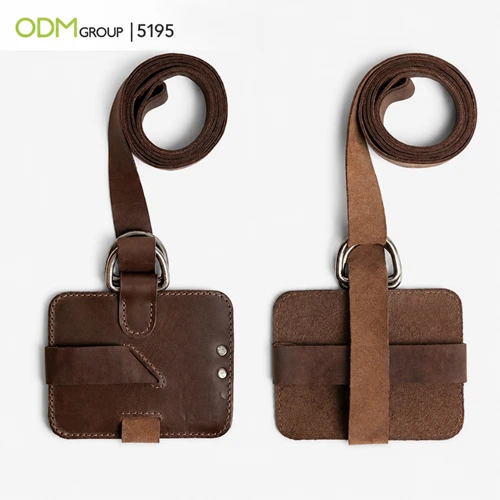
A book strap carrier supports these existing habits while giving the brand a visible role in the experience.
It also benefits from being less common than a tote bag. Familiar products can still work, but they often need stronger creative execution to stand out. A book carrier starts with a more distinctive form, helping the campaign feel considered from the outset.
For marketers, that difference matters. The product can become part of the campaign story rather than simply an item added at the end.
A Product That Keeps the Main Purchase Visible
One of the most interesting features of a book strap carrier is what it does not cover.
Unlike a bag, it leaves the book, notebook, or publication visible. This can be particularly valuable for campaigns where the main product already has strong visual appeal.
A publisher launching a new title may want the cover artwork to remain on display. A museum may want visitors to carry an exhibition catalog through the venue. A stationery brand may want its notebooks to remain visible after purchase.
The carrier supports the item without competing with it.
That makes it especially useful for brands selling design-led products. Instead of hiding the purchase inside packaging, the promotion can turn it into part of the customer’s look as they leave the store, event or exhibition.
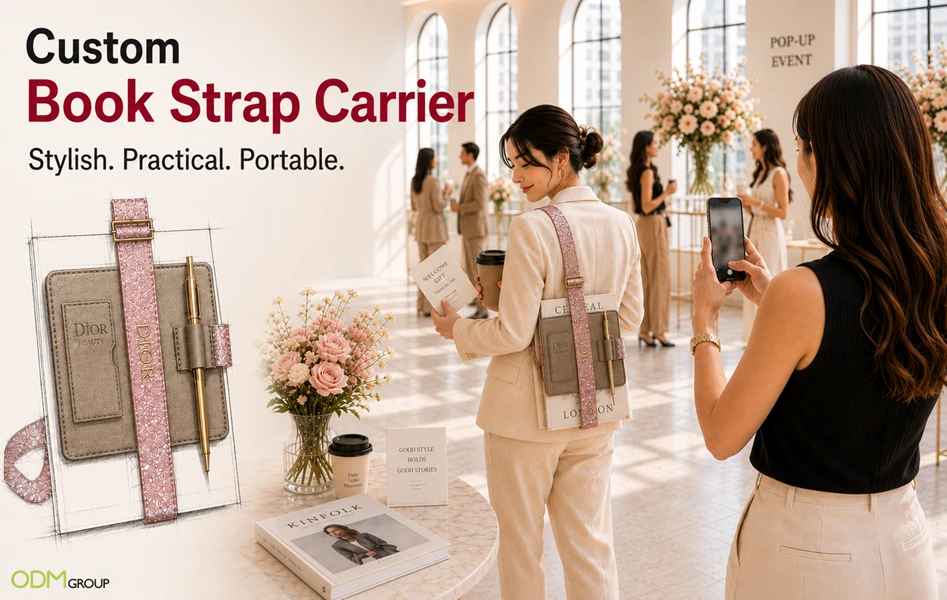
Where Book Strap Carrier Promotions Can Work
The strongest campaigns begin with a relevant use case. A book strap carrier makes the most sense when the product, audience and promotional setting naturally belong together.
1. Bookstores and Publishing Campaigns
For bookstores and publishers, the connection is immediate.
A carrier could be offered as a gift when customers purchase several books, join a reading program, or buy a selected new release. It could also support author events, literary festivals, collector editions, or book-club memberships.
The promotion becomes stronger when the carrier reflects the title or campaign. Color, typography, illustrated details, or a short message can make the item feel connected to the story rather than like a standard branded accessory.
For a limited-edition launch, the carrier can also add perceived value without requiring elaborate gift packaging.
2. Education and Campus Marketing
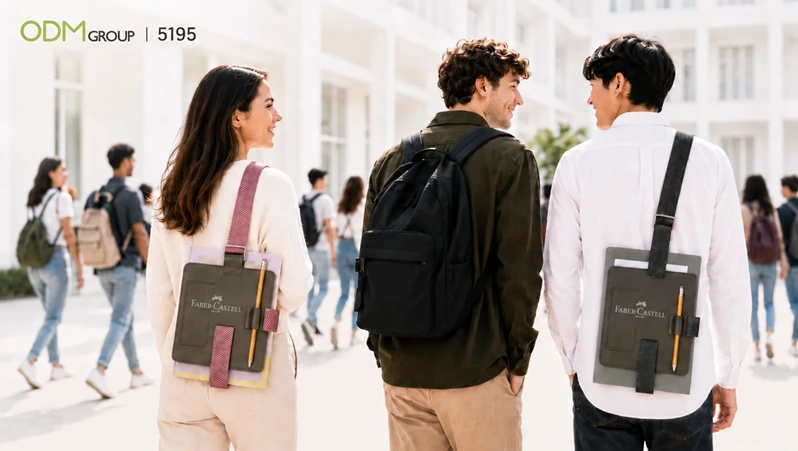
Schools, universities and education brands can use book carriers in welcome kits, student rewards, alumni programs and campus events.
The product may hold a notebook, a course guide, a reading pack, or event materials. Because it is lighter and more compact than a backpack, it can work well for short journeys between classrooms, libraries and study areas.
A good education campaign should also consider how the item supports identity. School colors, faculty details, or graduation-year branding can turn the carrier into something students associate with belonging, not just utility.
3. Museums, Galleries and Cultural Organizations
Cultural organizations are well placed to treat the book strap carrier as merchandise rather than a giveaway.
An exhibition-inspired version could carry catalogs, art books, postcards or sketchpads. Graphic elements from the exhibition can be translated into the strap, front panel or packaging.
This gives museums and galleries an additional way to extend the visitor experience beyond the venue. The carrier becomes a wearable reminder of the exhibition and a visible expression of the customer’s interests.
4. Corporate Learning and Events
Corporate gifting often relies on notebooks, planners, and business books. A book strap carrier can bring these familiar items together in a more intentional way.
It could support:
- Employee onboarding
- Leadership development programs
- Training workshops
- Speaker gifts
- Conference packs
- Internal learning campaigns
The value is not simply that the strap holds the items. It creates a cohesive presentation and gives recipients something they can continue using after the program ends.
5. Lifestyle and Creative Brands
For lifestyle brands, the carrier can move beyond functionality and become a design accessory.
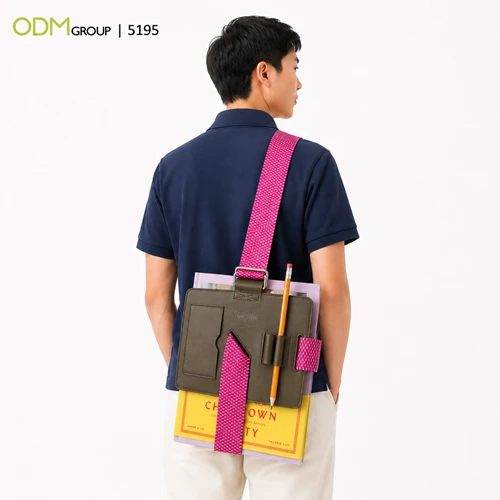
A minimalist version may appeal to commuters and professionals. A colorful woven design may work for younger audiences, festivals, or creative communities. Collaborations with illustrators, authors or designers can introduce a collectible element.
This is where restraint becomes important. The product needs enough brand identity to support the campaign, but not so much promotional messaging that customers stop using it afterward.
Stronger Campaign Mechanics
The product becomes more effective when it has a clear role in the promotion.
-
Gift With Purchase
A book strap carrier can reward customers who reach a purchase threshold.
A bookstore might offer it with three selected titles. A stationery brand could pair it with a notebook collection. A museum shop could include it in a catalog-and-print bundle.
The key is relevance. The carrier should help customers take home, organize, or use what they have just purchased.
-
Membership Reward
Book clubs, libraries, cultural institutions, and subscription services can use the carrier as a membership benefit or renewal reward.
A member-only color, numbered edition, or small identity marker can make the product feel exclusive without making it overly expensive.
This approach is particularly useful when the goal is retention. The item becomes a physical reminder of the customer’s relationship with the organization.

-
Launch or Press Kit
Publishers and lifestyle brands can use a book strap carrier to present a new release to media, partners, or creators.
Instead of placing everything inside a conventional box, the carrier can secure the main product together with supporting materials. The result is visually distinctive and may encourage recipients to include the item in unboxing content or campaign photography.
-
Event Merchandise
At conferences, exhibitions, and literary events, the carrier can help attendees manage notebooks, brochures, and printed materials.
This also creates mobile visibility throughout the venue. When multiple attendees carry the same design, the product becomes part of the event environment rather than a piece of merchandise seen only at the registration desk.
Branding That Encourages Long-Term Use
Promotional visibility matters, but excessive branding can reduce the lifespan of the product.
A large slogan may work for a one-day event but make the carrier less appealing afterwards. In contrast, colour blocking, woven patterns, discreet embossing or branded hardware can create recognition without overwhelming the design.
The right balance depends on the campaign objective.
For a short-term activation, bold branding may be appropriate. For a membership gift, fashion collaboration or premium retail promotion, subtle design cues are more likely to encourage regular use.
Brands should also consider the relationship between the carrier and its contents. The strap should complement the books or notebooks rather than visually overpower them.
Where the Idea Can Go Wrong
The book strap carrier is not a replacement for every type of bag.
It offers limited protection from rain, impact and damaged corners. It is not designed to carry multiple loose items, and heavier loads may become uncomfortable without the right structure.
This is why the intended use should remain focused.
Trying to add too many pockets, compartments and functions can weaken the simplicity that makes the product attractive. A carrier designed for books and notebooks should not become an overloaded messenger bag.
The best concepts are clear about what the product is for and communicate that purpose honestly.
Final Thoughts
A book strap carrier gives brands a more distinctive alternative to the usual tote or backpack. Its value comes from combining practical use with visible branding, making it a strong fit for publishing, education, retail, and event campaigns.
ODM Group can help bring the idea to life through product sketching, prototyping, factory selection, quality assurance, and delivery coordination.
Planning a custom book strap carrier for your next promotion? Contact ODM Group to develop a campaign-ready concept built around your brand, audience and distribution strategy.
ODM Services
FAQs about Book Strap Carrier
Can a book strap carrier be customized for different book sizes?
Yes. The strap length, carrier dimensions and fastening system can be adjusted to suit notebooks, textbooks, magazines or bundled gift sets.
Can brands add extra features to the carrier?
Yes. Options may include pencil holders, card slots, phone pockets, adjustable straps and branded hardware, depending on the campaign requirements.
Is a book strap carrier suitable for gift-with-purchase promotions?
Yes. It works particularly well for bookstores, publishers, stationery brands and education businesses because the gift directly supports the products being purchased.
How can ODM Group support the development process?
ODM Group can assist with concept sketches, prototype development, supplier selection, quality assurance and delivery coordination, helping brands manage the project from idea to rollout.
What to Read Next?
Book Strap Carrier for Smarter Brand Promotions
Promotional bags are everywhere, but a book strap carrier [...]
Gyroscope Toy: Why It’s a Must-Have Promotional Gift in 2026
As workloads increase and attention spans shrink, practical desk [...]
20 Back-to-School Merch Ideas From The ODM Group
It's that time of year again - the start of [...]
Custom Wall Organizer: Office Gift Idea for Project Managers
November 3rd is Project Management Day! It is a [...]
Add Flair to Employees’ Desk With Awesome Office Desk Gift Ideas
As the year comes to a close and the [...]

Celebrate World Post Day with Custom Paper Clips!
Marketing is a dynamic arena where standing out from [...]