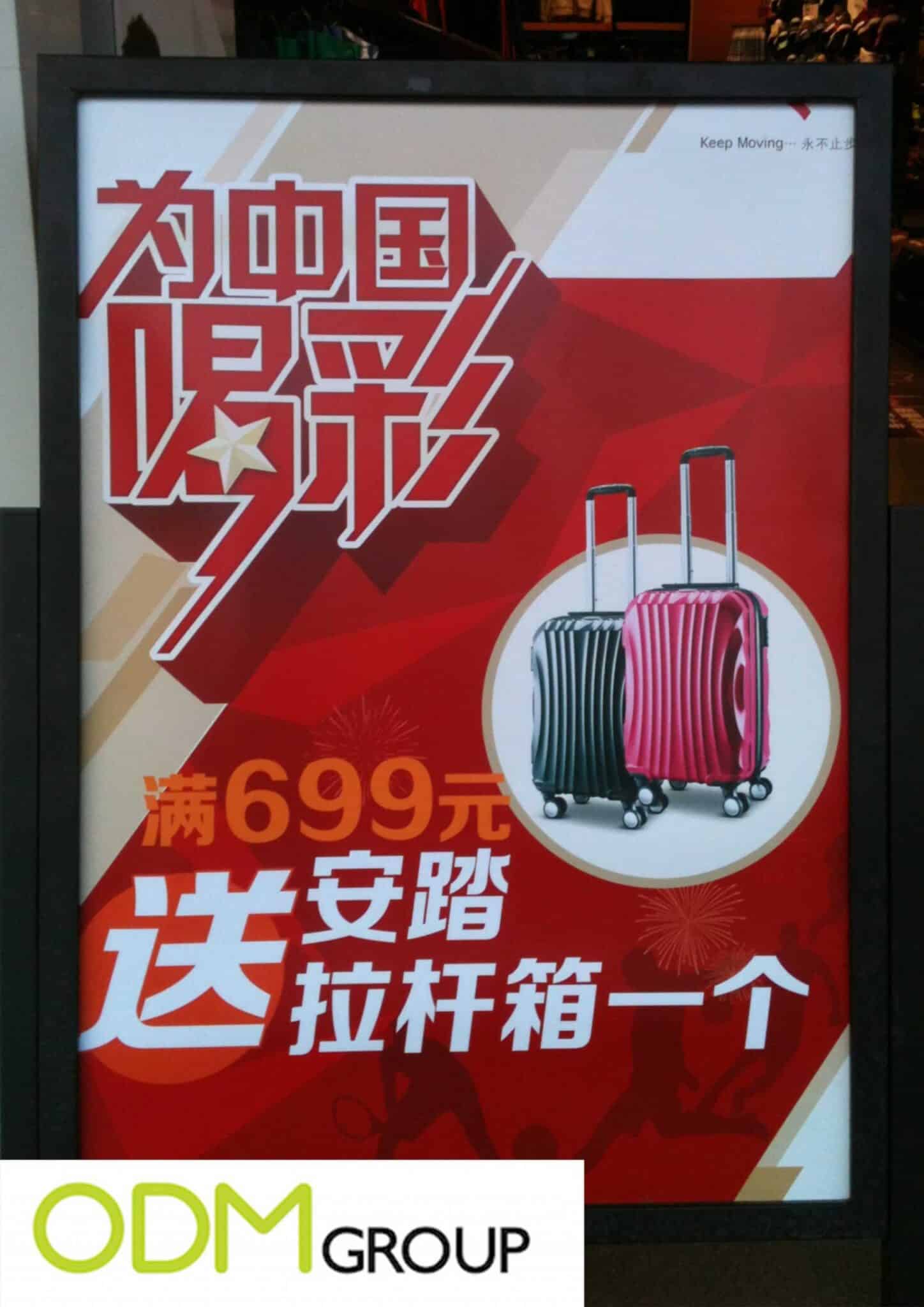
A strong gift-with-purchase campaign gives shoppers more than a reason to buy. It gives them a reason to remember the brand.
That is why promotional trolley bags can be such an effective retail incentive. They offer immediate value at the point of purchase, support larger shopping trips, and continue carrying the brand into supermarkets, neighborhood stores, and public spaces long after the campaign ends.
Dettol, Clear, Chao Neng, Unilever, Giordano, and other retail brands have all used trolley bags to strengthen purchase incentives. Their campaigns show how the same product can support different objectives, from increasing basket value to encouraging cross-brand purchases and reinforcing a lifestyle-led brand image.
Why Promotional Trolley Bags Work as Gifts With Purchase
The best promotional gifts fit naturally into the customer’s routine. A trolley bag does this particularly well because shoppers can understand its value immediately.
Unlike a small novelty item, it solves a practical problem. It helps customers carry groceries, personal care products, laundry supplies, and other heavier items. This makes it easier for shoppers to justify reaching a promotional spending threshold.
For the brand, the value continues after redemption. A trolley may be used repeatedly over an extended period, giving the campaign a longer life than the original supermarket display.
A well-planned trolley GWP can help a brand:
- Increase average transaction value
- Encourage purchases across several products
- Differentiate an offer from nearby competitors
- Improve the perceived value of a promotion
- Extend visibility beyond the retail environment
- Support loyalty and repeat-purchase programs
The product works because it connects the immediate sales objective with longer-term brand exposure.
Dettol’s Promotional Trolley Campaign
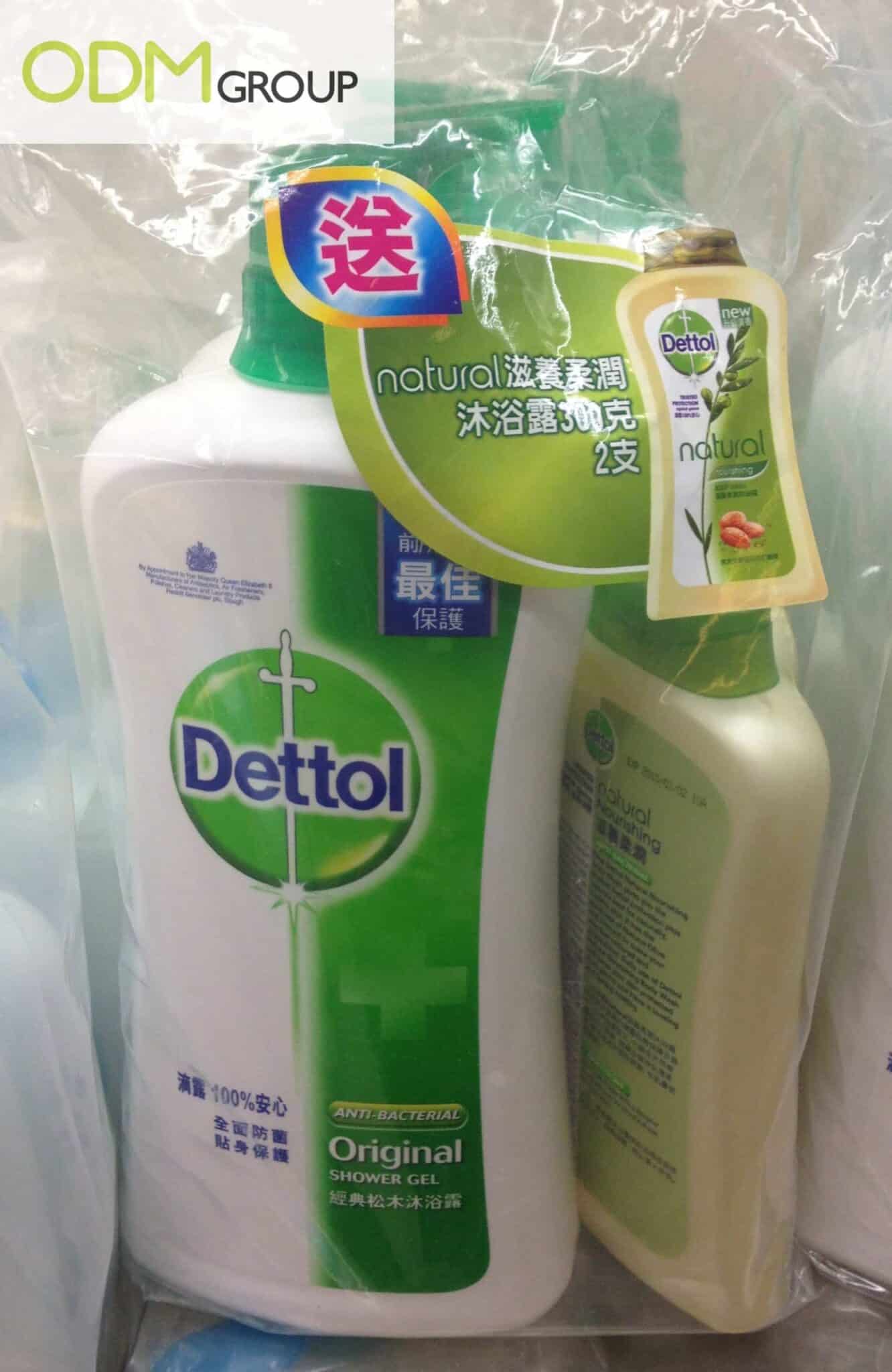
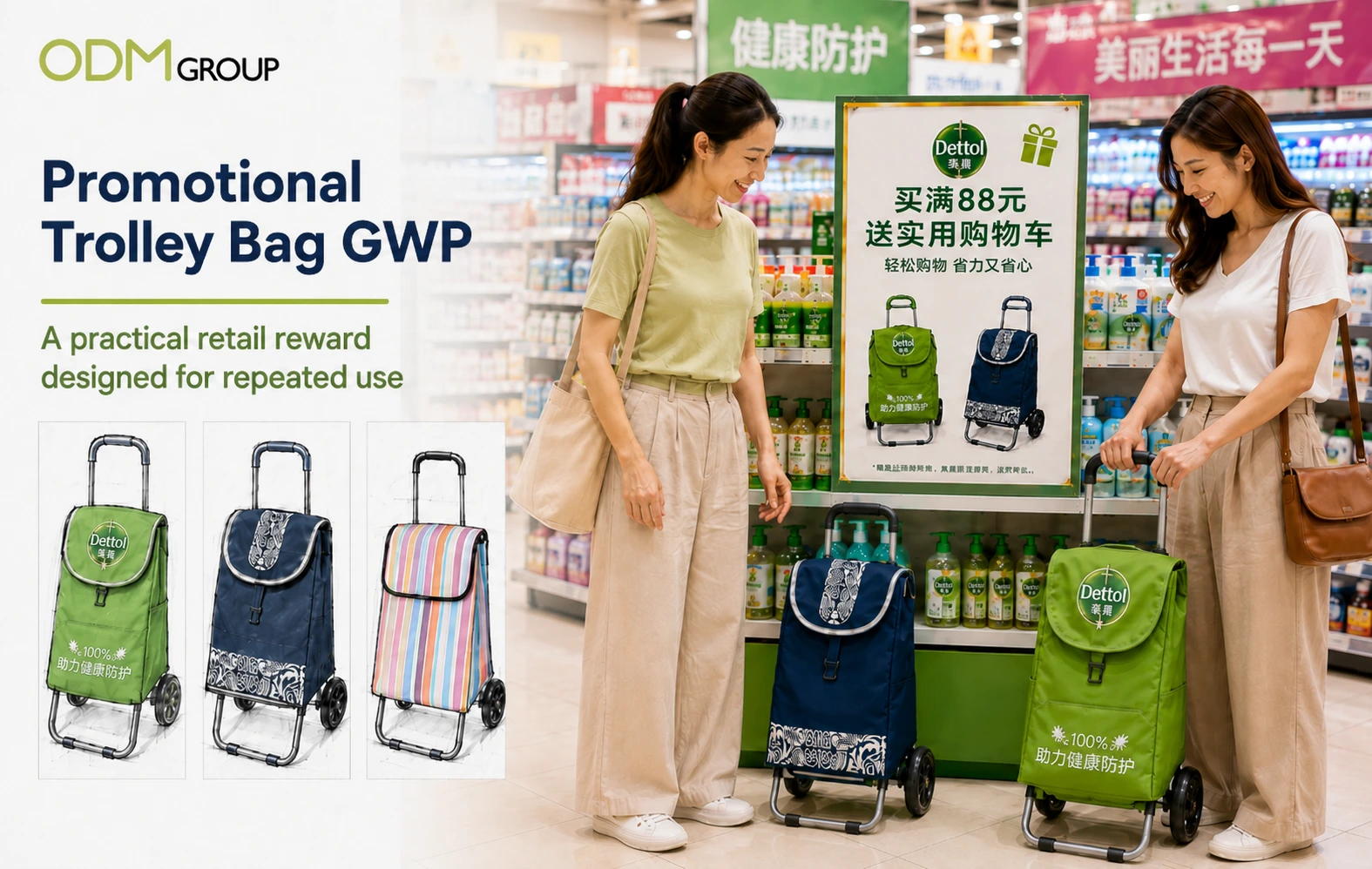
Dettol offered shoppers a branded trolley after they spent RMB 88 on qualifying products. The promotional mechanic was clear: purchase enough Dettol products to reach the threshold and receive the trolley as a reward.
The bright green fabric created a direct visual connection with Dettol’s identity. Large front-facing branding also made the gift easy to recognize when displayed beside the participating products.
More importantly, the trolley matched the shopping occasion. Customers purchasing multiple bottles of hygiene or personal-care products could immediately see how the reward would be useful.
The campaign combined three elements effectively:
- A straightforward purchase condition
- A gift with obvious everyday value
- Prominent placement near the qualifying products
This is a simple but effective retail formula. The shopper understands the offer quickly, sees the value of the reward, and knows which products to buy.
Chao Neng: Using Repetition to Build Impact
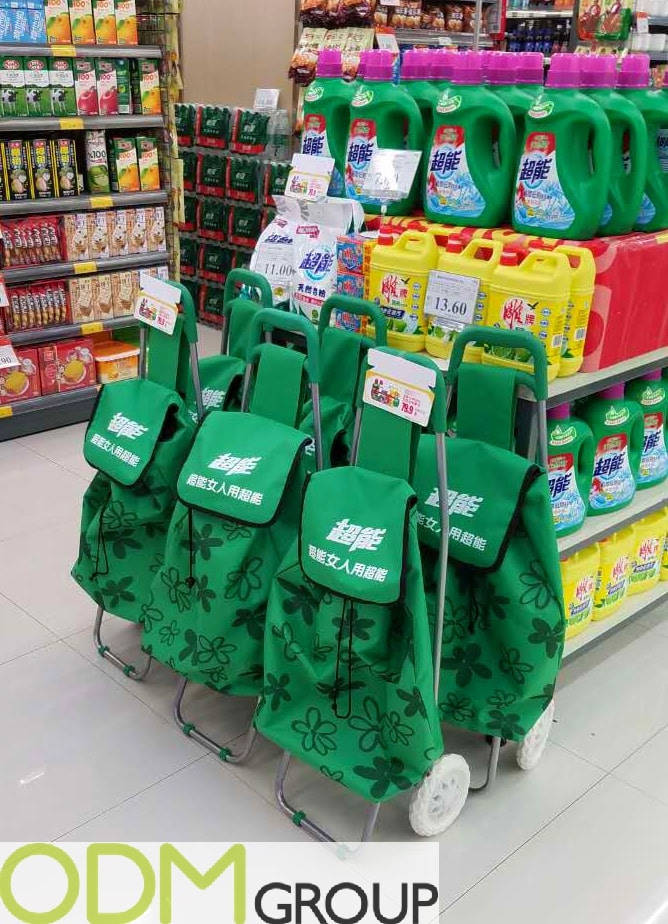
Chao Neng displayed several green trolley bags in front of a large laundry-care product feature. The repeated placement gave the promotion a stronger presence and made the free gift visible from further along the aisle.
The trolley color closely matched the product packaging, creating a coordinated presentation. Floral graphics added visual interest and made the gift feel more considered than a plain bag carrying a logo.
This is an important design principle. Promotional products tend to achieve greater long-term use when they look like complete consumer products rather than standard merchandise.
The Chao Neng example also shows how product quantity can influence perception. Displaying several assembled trolleys suggests abundance and value, while a single sample may be easier for shoppers to overlook.
Clear: A More Refined Trolley Design
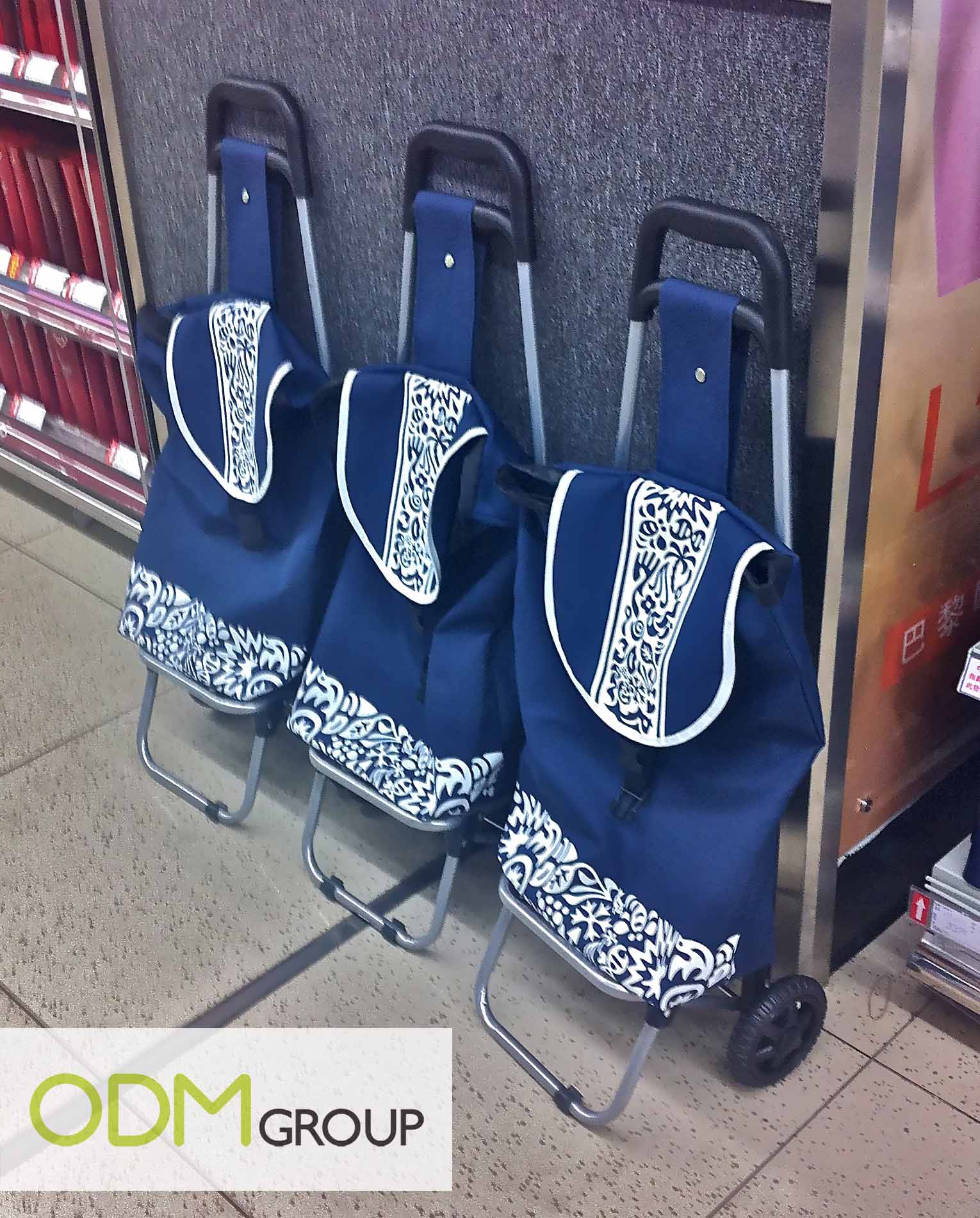
Clear took a different visual approach, using dark blue trolley bags with contrasting white patterns. The design was more understated than the brighter household-care examples, giving the product a cleaner and slightly more premium character.
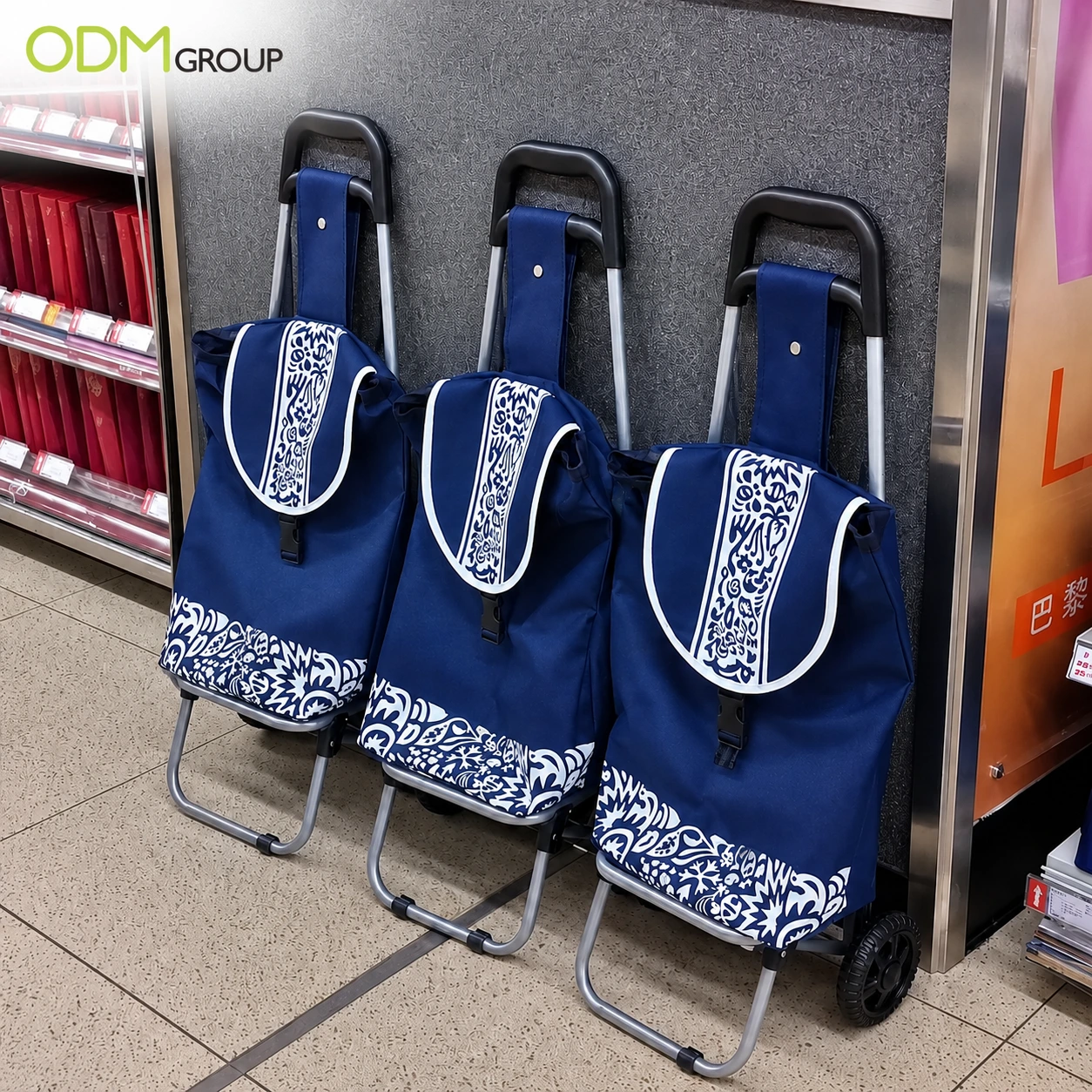
This matters because stronger branding does not always require a larger logo. A trolley that fits comfortably into the customer’s lifestyle may ultimately generate more impressions because the recipient is more likely to keep using it.
The Clear example demonstrates how decorative graphics, controlled color use, and balanced logo placement can increase the perceived quality of a promotional gift.
For beauty, personal-care, and premium consumer brands, this more restrained direction may be more effective than a design dominated by campaign messaging.
Unilever: Encouraging Cross-Brand Purchases
A Unilever campaign used a trolley bag to encourage shoppers to meet a minimum spend threshold on participating personal-care products.
This type of promotion is particularly useful for companies with multiple brands in a single retail category. Instead of focusing on a single product, the GWP can motivate customers to combine items from different ranges.
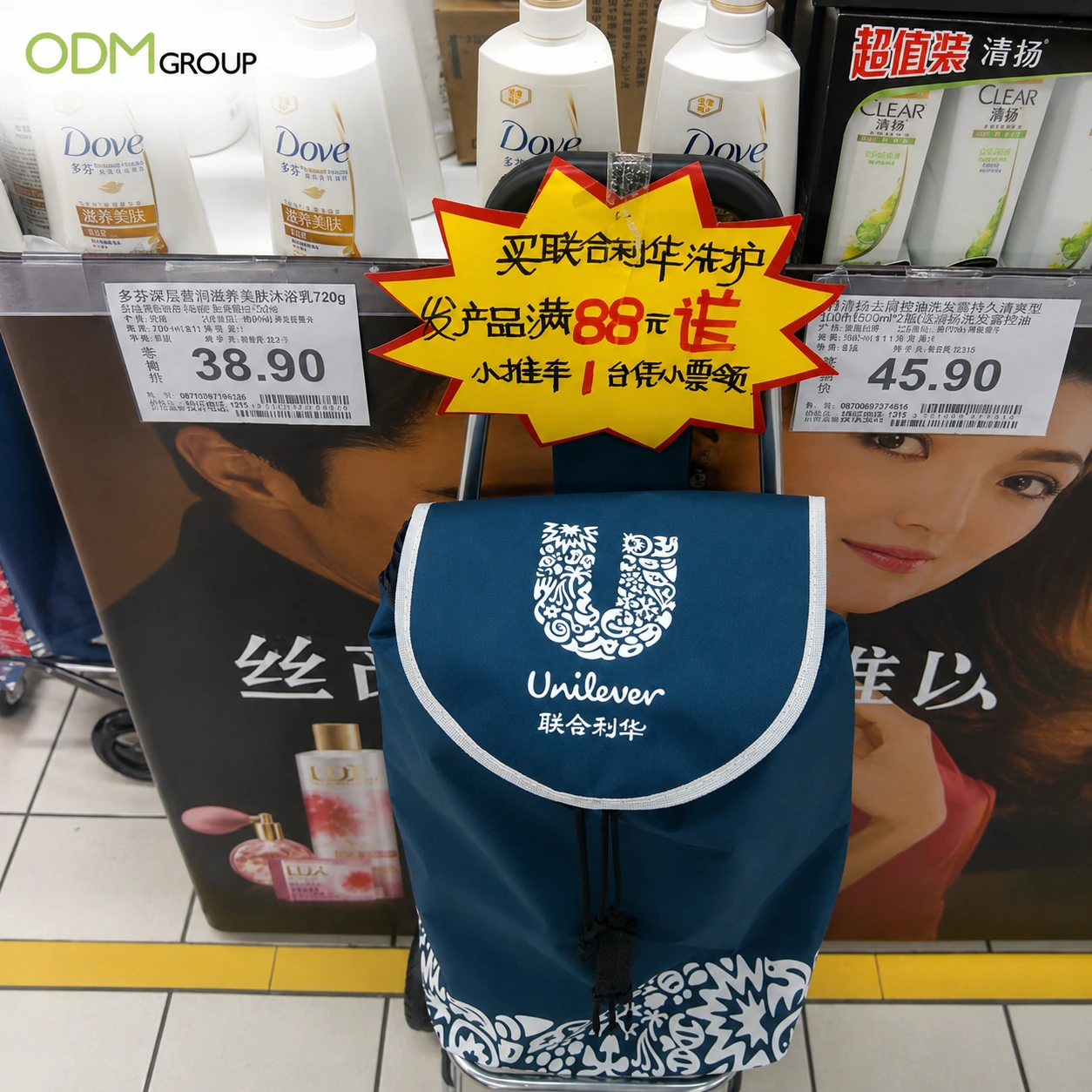
A shopper might purchase shampoo, body wash, and skincare products to reach the required amount. This supports broader product discovery while increasing the total value of the basket.
However, portfolio promotions depend on clear communication. Participating products must be easy to identify, and the spending requirement should not force shoppers to study complicated terms at the shelf.
The strongest multi-brand displays use consistent promotional graphics across product shelves, trolley signage, and redemption materials.
A Grocery Trolley Promotion Built Around Simplicity
The striped trolley example shows how a basic promotional message can still command attention when the product is displayed clearly.
A large “Free” sign was attached directly to the trolley, making the value proposition immediately visible. Shoppers did not need to interpret a complex display or search for the reward elsewhere in the store.
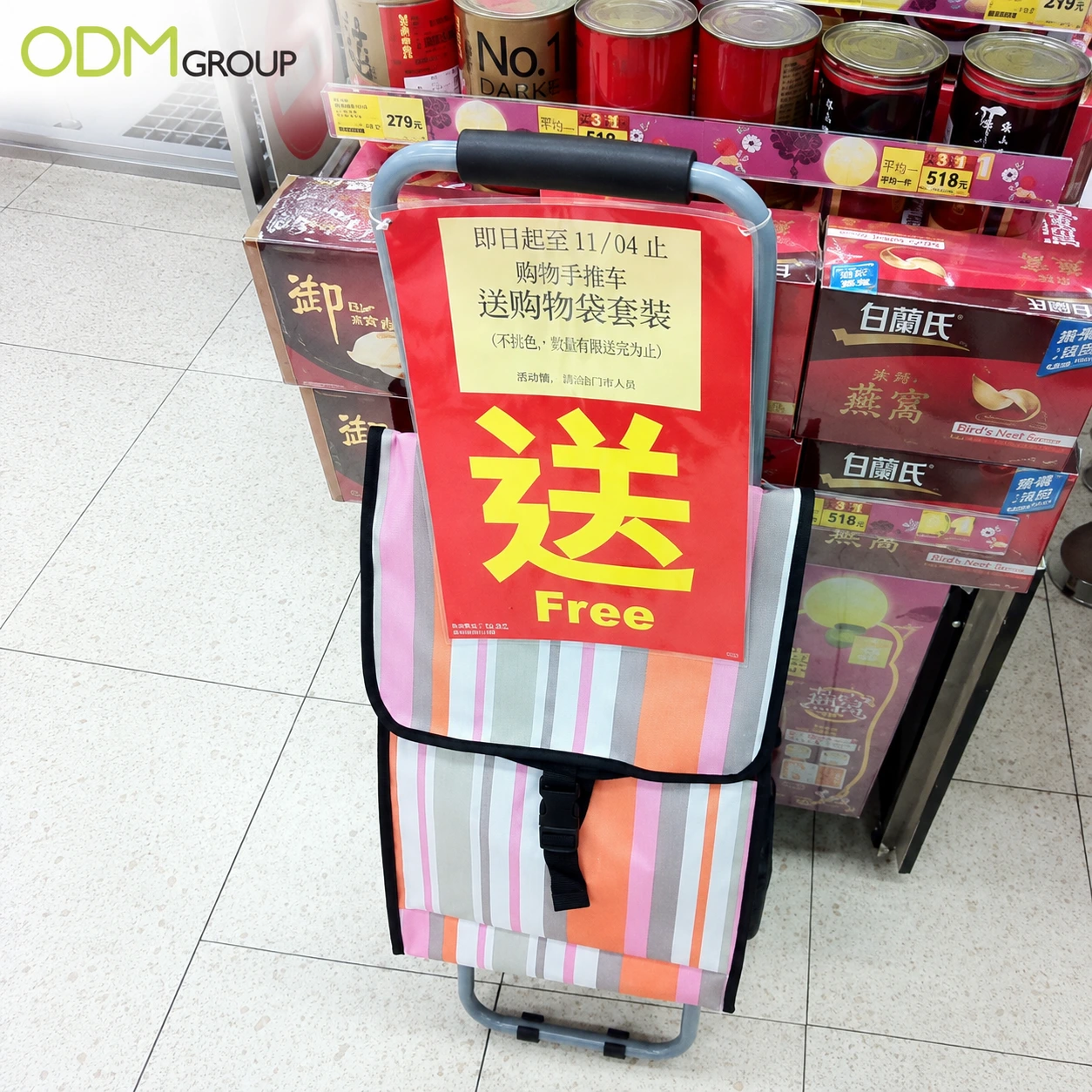
This direct approach is especially effective in busy grocery environments, where customers often make decisions quickly. The trolley itself becomes part of the communication.
The design also differs from heavily brand-colored examples. The striped pattern gives the trolley a more general lifestyle appearance, which may increase its appeal to customers who prefer less visible advertising on products they use in public.
The lesson is not that every promotion needs minimal branding. It is that visual appeal and practical use should be considered alongside logo exposure.
Giordano: Bringing the Trolley GWP Into Fashion Retail
Giordano demonstrates that trolley bags are not limited to supermarkets or household-care promotions.
According to the campaign signage, customers could receive the trolley free with an S$220 net purchase or purchase it for S$19 with an S$120 net purchase. This two-tier mechanic gave shoppers more than one way to participate.
The offer supported different customer behaviors. Higher-spending shoppers could receive the trolley as a reward, while customers making a smaller purchase could still access it at a reduced price.
This approach can help a retailer manage the cost of a higher-value promotional product without limiting the campaign to top-spending customers.
In a fashion environment, the trolley also takes on a different role. It becomes a lifestyle accessory rather than simply a grocery aid. The product design therefore needs to reflect the brand’s aesthetic and appeal to customers beyond the original transaction.
Giordano’s promotion shows how purchase-with-purchase and GWP mechanics can work together within the same campaign.
Check out these similar product ideas
Make your brand a part of everyone’s memorable traveling journey through these three multifunctional custom-made suitcases!
Due to the customizable, eye-catching lighting, this custom luggage bag is ideal for distinctive brand activation. Additionally, it could use such lighting to frame your brand.
Designed with a rock ‘n’ roll steering, this suitcase has a stable steering system for safety. It is also sturdy but squishy – a soft, bouncy surface to resist impact.
What the Strongest Trolley Promotions Have in Common
Although these campaigns vary in category and visual style, the most effective examples follow several shared principles.
The Gift Is Easy to See
An assembled trolley helps customers understand its size, appearance, and value. A small image on a shelf card is rarely as persuasive as showing the actual reward.
The Purchase Condition Is Clear
Shoppers should be able to identify the spending threshold or qualifying products within seconds. Unclear conditions create hesitation and reduce participation.
The Design Reflects the Brand
Colors, patterns, graphics, and logo placement should connect the trolley to the campaign. However, the design should still feel suitable for everyday use.
The Reward Fits the Shopping Occasion
The trolley works particularly well where customers are already purchasing multiple, bulky, or heavier products. This creates a natural relationship between the purchase and the gift.
The Product Has Value Beyond Redemption
The campaign does not end when the customer leaves the store. A reusable trolley continues creating impressions through repeated use.
Promotional Trolley Bag Design Directions
A trolley bag should be recognizable as part of the campaign without looking like disposable advertising.
Brand-Led Color Blocking
Signature colors can create immediate recognition. Contrasting trim, handles, flaps, and panels can add more depth than applying one color across the entire product.
Pattern-Based Designs
Botanical artwork, geometric graphics, ingredient illustrations, or seasonal themes can make the trolley more attractive and easier to use outside the campaign.
Minimal Lifestyle Designs
Subtle logos and controlled graphics can increase appeal for fashion, beauty, and premium retail brands. The brand remains visible, but the product feels less commercial.
Foldable Formats
A foldable trolley is easier for customers to store and more practical for retailers to distribute. Compact formats can also improve the presentation of packaged stock at the redemption point.
Removable or Multi-Use Bags
A detachable bag can be used separately from the frame, giving the product more than one function. This may improve perceived value and encourage more frequent use.
Category-Specific Features
Food and beverage campaigns may consider insulated linings, while personal-care or household campaigns may benefit from internal compartments or reinforced sections for larger bottles.
Features should support the target customer’s routine rather than simply add cost.
Choosing the Right Promotional Mechanic
The value of the trolley should be reflected in the structure of the promotion.
Minimum-Spend GWP
This is the most direct way to increase basket value. The threshold should feel achievable without making the reward seem too easy to obtain.
Multi-Product Purchase
Brands can require customers to purchase several products from the same range. This is useful for product discovery and category-building campaigns.
Cross-Brand Promotion
Companies with larger portfolios can allow shoppers to combine purchases across participating brands, as seen in the Unilever example.
Purchase With Purchase
Customers gain access to the trolley at a reduced price after buying qualifying products. This helps the brand manage costs while preserving the gift’s perceived value.
Loyalty Redemption
The trolley can be offered after several purchases rather than one transaction. This approach supports customer retention and repeat visits.
Why POS Design Matters
A trolley promotion depends on more than the gift itself. The point-of-sale materials must explain the offer, guide shoppers toward the qualifying products, and make redemption feel straightforward.
An assembled trolley should ideally appear near the product display. Shelf talkers, header cards, floor stands, endcap graphics, and counter materials can then reinforce the purchase condition.
The most important information should remain easy to scan:
- What the customer receives
- How much they need to spend
- Which products participate
- How and where the gift is redeemed
- Whether availability is limited
A clear retail hierarchy is more effective than filling the display with excessive promotional copy.
For stronger campaigns, the product design and POS system should be developed together. The same color palette, graphics, and messaging can connect the trolley with the qualifying products and create a more cohesive in-store experience.
Which Brands Can Use Promotional Trolley Bags?
Trolley GWPs are particularly relevant to brands that sell multiple products or larger packs through retail channels.
They can work well for:
- Household and laundry brands
- Personal-care companies
- Food and beverage businesses
- Baby-care and pet-care brands
- Pharmacies and health retailers
- Supermarkets and membership clubs
- Fashion and lifestyle retailers
- Loyalty and seasonal campaigns
The Giordano example confirms that the opportunity extends beyond FMCG. The key question is whether the trolley feels relevant to the target customer and valuable enough to influence the purchase.
How ODM Can Support a Trolley GWP Campaign
ODM Group can help brands develop trolley promotions from concept to retail execution. Support can include product sketches, prototyping, suitable factory selection, quality assurance, and POS design.
By coordinating the promotional product with its in-store presentation, ODM helps create a clearer and more consistent campaign across the gift, display, and customer experience.
Planning a promotional trolley bag campaign? Contact ODM to develop the product concept and supporting POS materials for your next retail promotion.
More Product Ideas


Frequently Asked Questions
Are promotional trolley bags only suitable for supermarkets?
No. They can also work for fashion retailers, loyalty programs, pharmacies, membership clubs, and seasonal campaigns.
Should a promotional trolley feature a large logo?
The branding should be recognizable, but it does not need to dominate the product. A balanced design may encourage customers to use the trolley more frequently.
How should trolley bags be presented in-store?
An assembled sample should be placed close to the participating products. Supporting POS should clearly explain the spending condition and redemption process.
Which GWP mechanic is most effective?
Minimum-spend promotions can increase basket value, while loyalty programs support repeat purchases. Purchase-with-purchase mechanics can help manage the cost of higher-value trolley designs.
Latest Blogs
Customized Cluster Bells: Inspiring Promotional Gift Ideas for Baby Brands
Customized Cluster Bells offer an interesting example of how [...]
Airplane Promotional Products: How STARLUX Airlines and CITY PRIMA Engage Customers
Airplane promotional products can do more than display a brand [...]
Event Branding Ideas: Make Every Touchpoint a Brand Experience
Event branding ideas turn separate venue elements into one [...]
Waterproof Camping Blanket: Take Your Brand Into the Outdoors
A waterproof camping blanket gives brands a useful role [...]
Custom Letter Envelope Opener Ideas for Corporate Gifts
A letter envelope opener may be a simple desk [...]
LED Screen Backpack: Smart Walking Billboards for Campaigns
Static outdoor signage and traditional promotional merchandise [...]