
A store loyalty program should give customers a clear reason to return—not simply another card to carry or app to ignore. The strongest programs connect a simple earning mechanic with a reward people genuinely want, then make that journey visible throughout the store.
For retailers, the opportunity goes beyond short-term sales. A well-designed program can increase visit frequency, support a target category, encourage customers to complete a collection, and create useful first-party behavioral signals. Physical rewards, custom packaging, and point-of-sale displays make the program tangible at every step.
What Is a Store Loyalty Program?
A store loyalty program rewards shoppers for completing defined actions, such as making repeat purchases, reaching a spending threshold, buying from a featured category, referring a friend, or visiting within a set period. Rewards may include merchandise, collectibles, discounts, services, member access, or exclusive experiences.
For physical retail, the best programs are easy to understand at a glance and easy for store teams to administer. Customers should quickly know what they need to buy, what they will earn, how progress is recorded, and when or where they can redeem.
Why Physical Rewards Strengthen Retail Loyalty
Points have little emotional value until customers can imagine the outcome. Merchandise gives the goal shape, function, and perceived value. It can also remain in homes, bags, offices, or social content long after a promotion ends.
- Visible value: Customers can see what they are working toward before committing.
- Collectibility: A series creates curiosity and encourages repeat participation.
- Brand exposure: Useful or displayable items extend visibility beyond the checkout.
- Member distinction: Exclusive designs make participation feel more valuable.
- Campaign flexibility: Rewards can support seasons, collaborations, launches, or priority categories.
MINISO Collect and Unbox: A Practical Example
MINISO Philippines’ “Collect and Unbox” promotion shows how a familiar stamp-card structure can be connected to a highly collectible product category. Shoppers may earn one stamp for each eligible blind-box figure purchased on a single receipt, priced at PHP 349 or more. Six stamps can be redeemed for one eligible blind-box figure, subject to the promotion’s conditions.
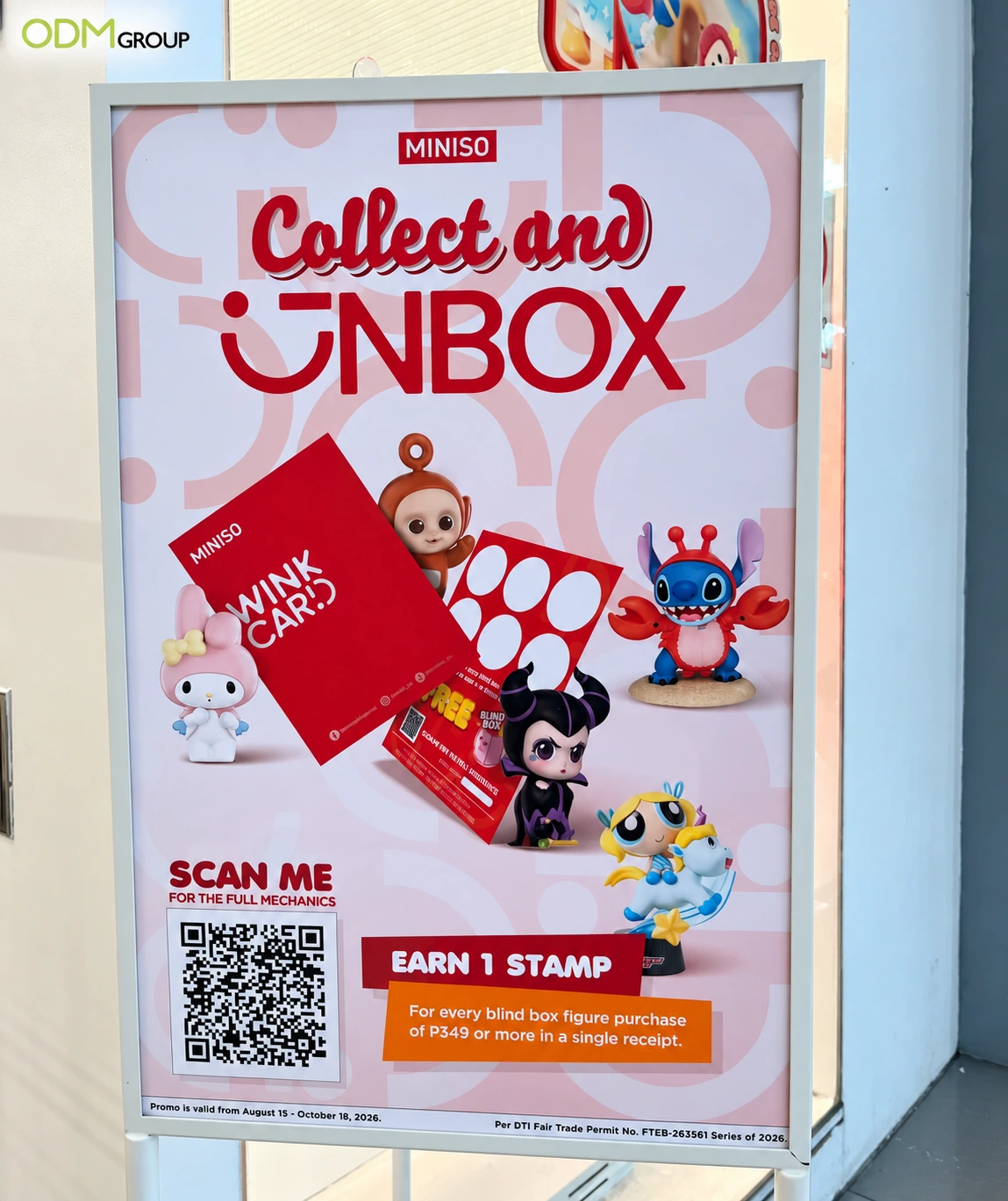
The campaign runs from August 15 to October 18, 2026 across participating standalone, SM Markets, and franchise branches. The in-store poster combines the reward proposition, character imagery, loyalty card, and a QR code leading to the full mechanics.
What B2B Teams Can Learn From the Program
1. The reward matches the qualifying category. Customers who already buy blind boxes are encouraged to buy again within the same interest category. The reward is not random; it reinforces the category behavior the retailer wants to grow.
2. Progress is concrete. Six stamps create a finite, understandable target. Customers can see how close they are to redemption, which can create a stronger completion impulse than an abstract points balance.
3. The reward retains customer choice. Eligible customers can select from participating blind-box items within the stated value limit. Choice can improve perceived value, although it also requires disciplined stock planning.
4. The campaign works across participating locations. Cross-store earning and redemption reduce friction for customers, but they require consistent training, recordkeeping, eligibility rules, and inventory visibility.
5. The POS material separates the hook from the detail. The headline conveys the emotional idea—collect and unbox—while the QR code contains the full mechanics. This keeps the main message accessible without eliminating necessary terms.
How to Build a Store Loyalty Program That Performs
Define the action the program should change. “Increase loyalty” is too broad. A stronger objective might be increasing purchase frequency in a category, lifting average transaction value, reactivating dormant members, encouraging cross-category trial, or bringing app members into physical stores.
The earning rule must be simple enough to explain in one sentence. Common structures include:
- Purchase-frequency rewards: Buy a qualifying item a set number of times.
- Spend thresholds: Earn a stamp or reward when you reach a transaction threshold.
- Tiered membership: Unlock better merchandise or access at higher levels.
- Collect-and-complete: Gather characters, colors, components, or themed items.
- Mission-based programs: Complete several actions across categories or channels.
Work backward from the commercial goal. Calculate the expected qualifying revenue, reward landed cost, packaging, display production, store handling, replacement allowance, and unredeemed liability. A reward should feel more valuable than it costs, but the program still needs a defensible margin structure.
- Set a reward cost ceiling before concept development.
- Model low, expected, and high redemption scenarios.
- Allow for damaged stock, replacements, and branch rebalancing.
- Check whether the threshold is motivating without being reached in one routine visit.
Reward selection should reflect the customer, brand, and campaign objective. Generic gifts may be easy to source, but exclusive products create a stronger reason to participate. Retailers can develop character collectibles, reusable drinkware, mini bags, desk accessories, travel items, home products, tech accessories, or seasonal gift sets.
A series can encourage repeat visits, but every item should still feel complete on its own. Consider colorways, rarity, displayability, utility, and whether customers will understand the collection at a glance. For licensed characters or collaborations, artwork approval, territory rights, safety requirements, and production timelines must be locked in early.
Here are collectible ideas you may consider:
Canned stuffed animals combine two familiar product formats into one memorable promotional item: a soft plush toy packaged inside a branded can.
The fun and excitement of collecting toys have been invaluable to people. Toy trucks are a great example of the power of collectible toys.
Pens, bags and drinkware are useful, but the branding experience is largely passive. A crank music box gives the recipient a simple action followed by an immediate reward.
Packaging influences perceived value before the merchandise is opened. Blind-box packaging adds surprise, while window boxes communicate certainty. Sleeves, numbered editions, collectible inserts, and connected designs across a series can strengthen the completion experience.
- Use a consistent architecture so every item is recognizable as part of one program.
- Make eligibility or series information easy for staff and customers to identify.
- Protect the item through distribution without adding unnecessary volume.
- Consider recyclable materials and right-sized structures where practical.
A loyalty program cannot rely on staff explanation alone. Window graphics, shelf talkers, counter units, standees, redemption-zone displays, and digital screens should communicate the same hierarchy: action, progress, reward, deadline, and next step.
Show the actual reward prominently. Place detailed terms and exclusions in a readable secondary layer, or connect shoppers to them through a QR code. Displays should be adapted to each retail format rather than reduced to one artwork file used everywhere.
Reward stock may need to move differently from saleable inventory. Decide whether redemption can happen at any participating branch, how stores will verify eligibility, how popular designs will be allocated, and what happens when a selected item is unavailable. Clear substitution rules protect both the customer experience and campaign margin.
Create a compact playbook covering card or account issuance, qualifying SKUs, returns, damaged cards, redemption, stock handling, privacy, escalation, and end-of-campaign procedures. Test the workflow with cashiers and store managers; they often identify friction that campaign teams miss.
Loyalty Program Ideas
Eximbank once again piques the interest of its clients with its exclusive bank loyalty programs. New and existing customers can take home special merchandise once they meet the promotional campaigns’ requirements.
Citimart, one of the Philippines’ oldest supermarkets, continues to gain customers through its loyalty program. Loyal customers can redeem the store’s promotional incentive merchandise by accumulating the required points for each specific home appliance.
We have an office based in Zhuhai, and recently we received this redemption gift coupon from a local salad bar nearby. They are offering in-store redemption gifts as part of their customer loyalty program.
Merchandise Ideas by Loyalty Objective
| Objective | Reward direction | Why it can work |
|---|---|---|
| Increase visit frequency | Collectible character series, pins, charms, mini figures | Multiple designs create a reason to return and complete a set. |
| Lift transaction value | Premium drinkware, bags, homeware, travel accessories | A higher perceived-value reward can support a meaningful spend threshold. |
| Grow membership | Welcome kit, cardholder, pouch, member-only packaging | An immediate physical benefit makes joining feel tangible. |
| Encourage category trial | Category-linked tools or accessories | The reward reinforces use of the featured product category. |
| Retain VIP customers | Numbered editions, curated gift boxes, personalized items | Exclusivity distinguishes the highest-value relationship tier. |
| Support seasonal traffic | Festive collectibles, gift sets, reusable decorations | A limited window adds urgency and refreshes the store story. |
More Product Ideas


Metrics B2B Teams Should Track
Measure the program against the commercial behavior chosen at the start. Useful indicators include:
- Participation rate among eligible transactions
- Average basket value of participants versus nonparticipants
- Time and number of visits required to complete the program
- Redemption and breakage rates
- Incremental margin after reward, packaging, POS, and handling costs
- Reward preference, stock-outs, and substitutions by location
- Repeat purchase rate after redemption
- Checkout time, staff errors, and customer-service cases
Avoid treating card distribution or app enrollment as proof of loyalty. The program succeeds only if it changes profitable customers’ behavior and leaves shoppers with a positive experience.
Common Mistakes to Avoid
- Choosing inexpensive rewards that customers do not value
- Making the threshold too easy, too distant, or difficult to explain
- Launching displays before reward stock and staff training are ready
- Using inconsistent mechanics across branches and channels
- Hiding major exclusions in terms customers see only after purchase
- Ignoring redemption demand by design, size, color, or location
- Measuring participation without measuring incremental profitability
How ODM Supports Store Loyalty Programs
ODM helps brands and retailers turn a loyalty strategy into a coordinated physical campaign. Our role is not to operate loyalty software or points databases. We focus on the product and retail touchpoints that make the program desirable, visible, and workable.
1. Custom Loyalty Merchandise
We develop reward concepts around the target audience, campaign mechanics, cost parameters, and intended retail behavior. Support can cover product ideation, sketch designs, 3D visualization, prototyping, factory selection, quality control, and logistics.
2. Packaging Design
Through Mindsparkz, ODM can design packaging that increases perceived value and connects individual rewards into a recognizable collection. This may include blind boxes, gift boxes, sleeves, inserts, display-ready packaging, and campaign-specific graphics.
3. POS Display Design
We can develop counter displays, freestanding units, shelf communication, redemption displays, and other POS materials that explain the earning journey and showcase the reward. Structural design can be adapted to accommodate storage footprints, product weight, installation requirements, and campaign duration.
Coordinating merchandise, packaging, and display development under one creative direction helps the customer see one campaign—not three disconnected production jobs.
Final Thoughts
A strong store loyalty program turns repetition into anticipation. Customers understand the next action, value the reward, and can see their progress without unnecessary effort. For retailers, the program connects commercial targets with a physical experience that can be measured and improved.
The merchandise attracts attention, the packaging builds perceived value, and the POS display makes the journey easy to follow. When those components are developed together—and supported by realistic economics, inventory planning, and store procedures—a loyalty campaign can do more than generate transactions. It can give customers a reason to come back.
| Start your project with ODM Group. Discuss custom loyalty merchandise, packaging, and POS display development at www.theodmgroup.com or info@theodmgroup.com. |
FAQs about Store Loyalty Programs
Should loyalty merchandise be branded heavily?
Not always. Subtle branding often improves everyday use, while character-led or campaign-led designs may support stronger visibility. The right approach depends on whether the reward is meant to feel like merchandise, a collectible, or a premium gift.
How early should custom loyalty merchandise be developed?
Start early enough for design, samples, approvals, testing, production, packaging, freight, and store allocation. Licensed artwork, multiple SKUs, custom molds, and peak-season manufacturing require additional lead time.
Can loyalty rewards support sustainability goals?
Yes, when the reward is durable, useful, appropriately packaged, and produced with considered materials. Sustainability claims should be specific and supported rather than based on vague “eco-friendly” language.
What makes a store loyalty reward effective?
It should be relevant to the customer, visibly worth earning, financially workable, and easy to redeem. Exclusivity, utility, collectibility, or personalization can raise perceived value without relying only on a high retail price.
What to Read Next?
Split-Flap Displays for Events, Retail and Brand Activations
Struggling to make your brand stand out in a crowded [...]
Beer Swag Ideas: Lessons from Heineken Silver’s Taiwan Campaign
Beer swag is evolving beyond traditional bottle openers and [...]
Car Tissue Holder: A Creative Automotive Promotional Gift
A car tissue holder can be more than a [...]
6 Tips for a Sustainable and Functional Promotional Travel Kit
A promotional travel kit combines practical travel essentials with [...]
Promotional Products for Pets: Ideas Inspired by SmartHeart Pet’s Homie
During a visit to Vietnam, the ODM team came [...]
15 Promotional Products for Universities to Celebrate World Students’ Day
Promotional products for universities work best when they support [...]