Free promotional items can give customers an additional reason to consider a product, particularly when the giveaway is useful, relevant or connected to a wider campaign. For FMCG brands, the challenge is choosing merchandise that supports the marketing objective while remaining practical to manufacture, package and distribute.
Historical Nestlé promotions involving Milo, Bear Brand and Nido provide useful examples of how branded merchandise and point-of-sale displays can work together in retail marketing.
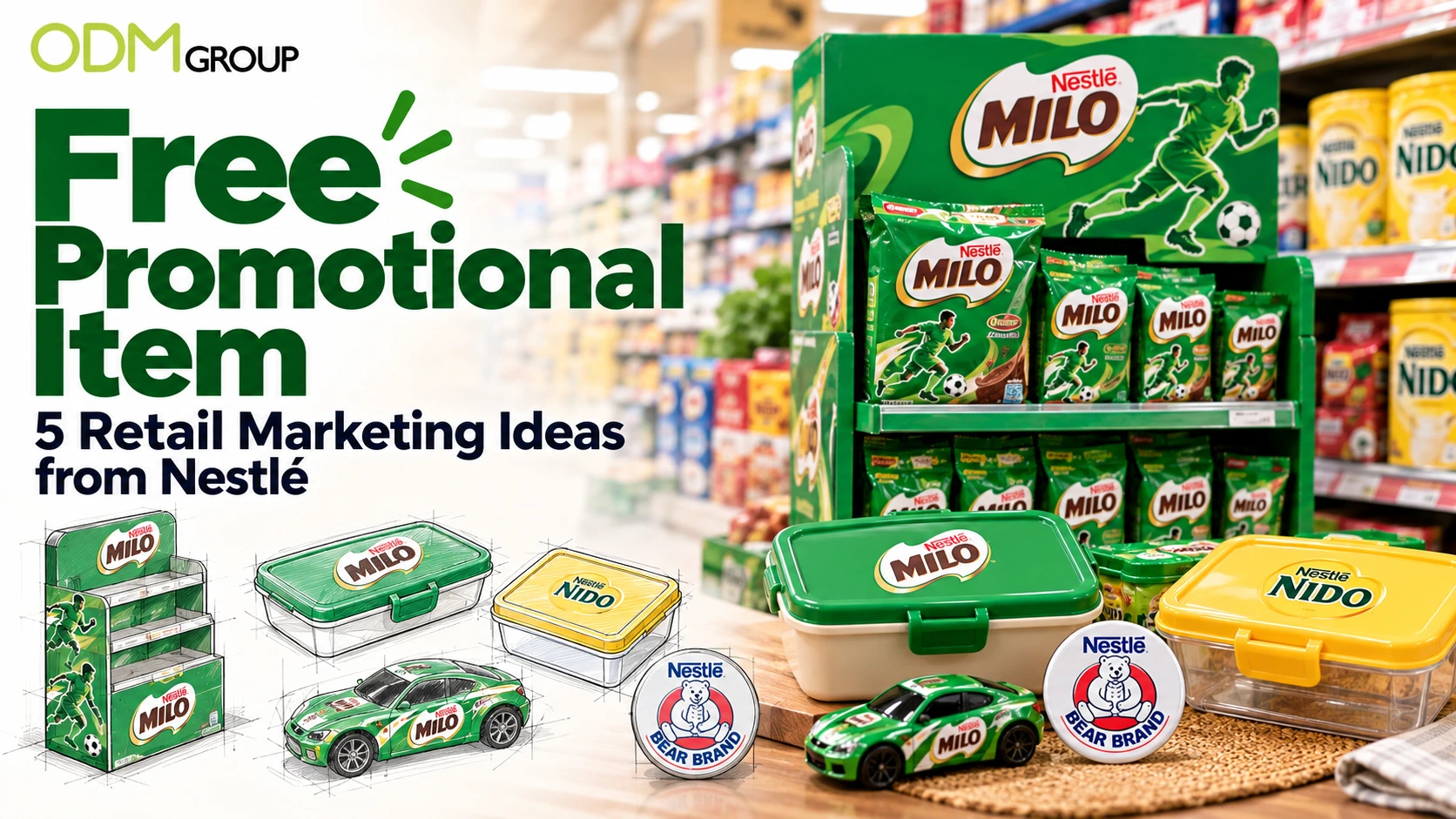
From reusable food containers to collectible toys, these examples show how different promotional products can appeal to different audiences and shopping occasions.
The campaigns discussed below are historical retail observations documented by ODM Group. They are not current Nestlé offers or confirmed ODM manufacturing projects.
Nestlé’s Free Merchandise Campaign
1. Milo Sandwich Container: A Practical Free Promotional Item
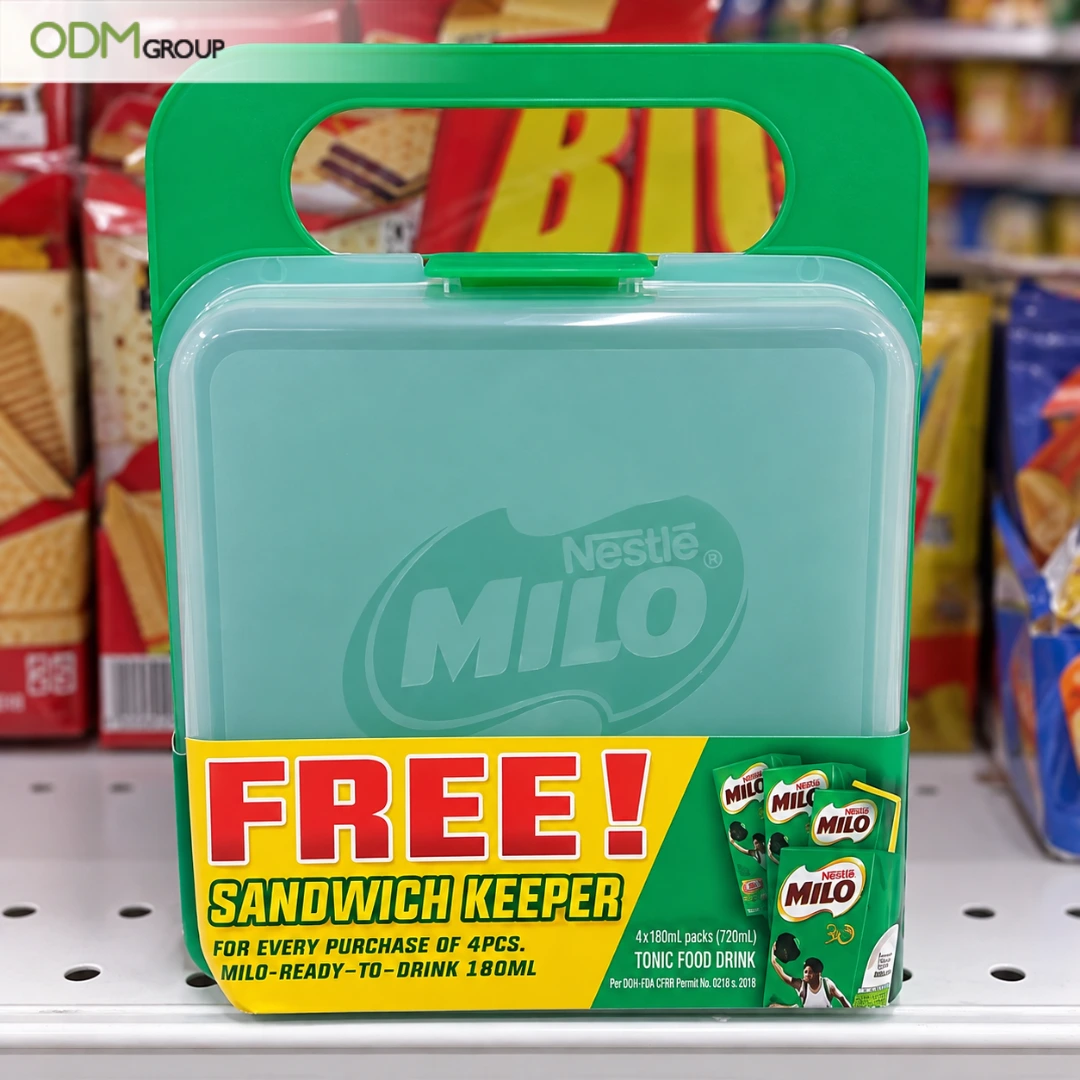
One historical Milo promotion featured a branded sandwich container.
This example illustrates how brands can select free promotional items that connect with everyday activities.
A reusable food container offers a practical function beyond the initial purchase. When the product is relevant to the customer’s routine, it may continue to be used after the promotion ends.
For brands considering similar merchandise, product development decisions include:
- Material: Choose materials suitable for the intended use, including applicable food-contact requirements.
- Size and capacity: Ensure the container is practical for its target audience.
- Branding: Position the logo or artwork where it remains visible without affecting functionality.
- Closure design: Assess the lid, hinges or clips during sampling.
- Packaging: Consider protection, storage and the method of promotional distribution.
Food-contact suitability, cleaning instructions and any microwave or temperature-related claims should be supported by the final product specification and appropriate testing.
The Milo example demonstrates why product relevance matters when selecting a free promotional item. Merchandise should serve a recognizable purpose rather than simply carry a logo.
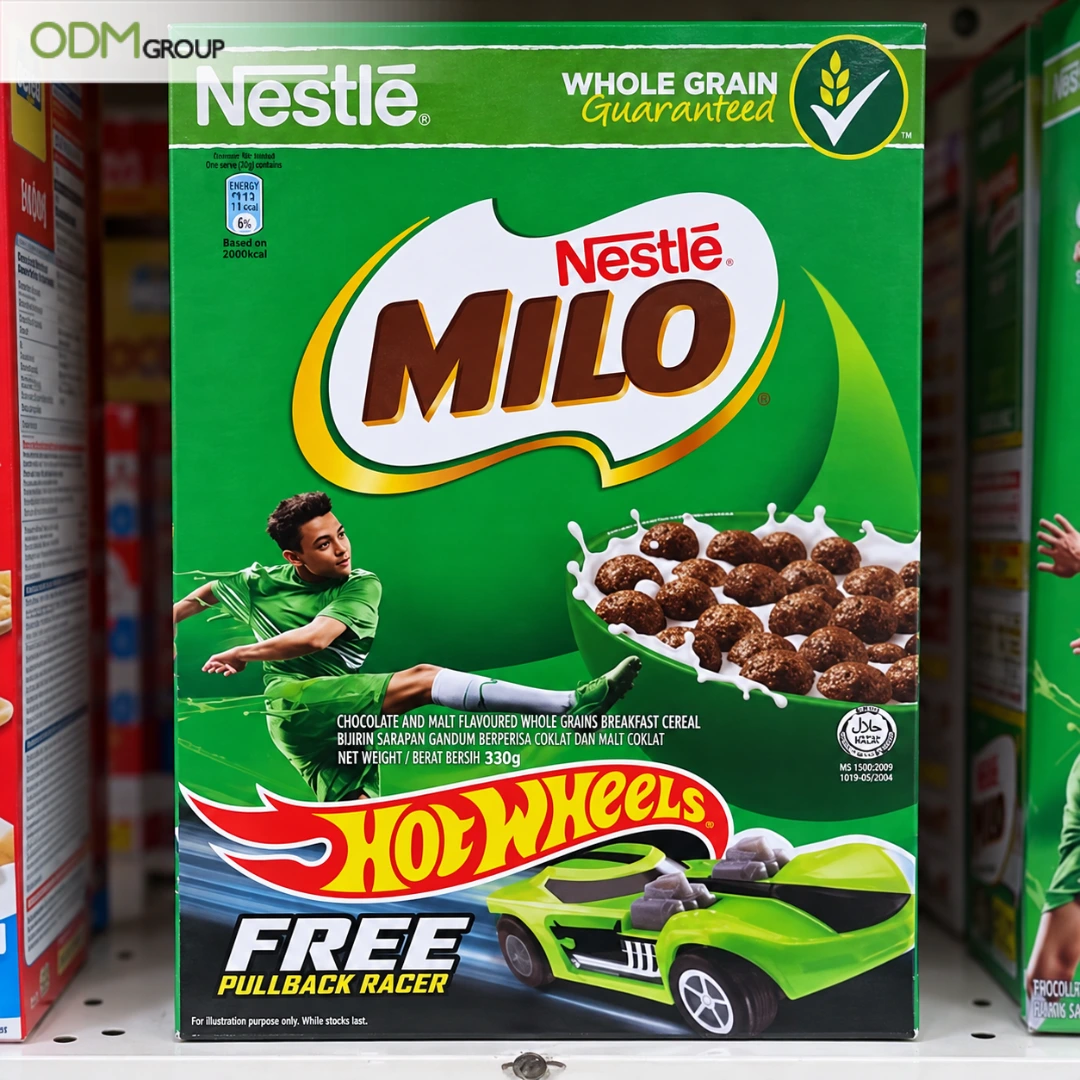
2. Milo Toy Car: Collectible Free Promotional Items
The original article also documents a Milo promotion involving a toy car associated with Hot Wheels. Collectible merchandise offers a different proposition from practical household gifts.
A toy car may appeal through its design, entertainment value or connection with an established toy brand. Where a campaign includes multiple designs, the collection itself can become part of the promotional concept. However, collectible free promotional items require careful planning.
Licensing and Brand Approval
Using an established toy brand or licensed character may require permission from the rights holder.
Artwork, packaging and promotional materials may also be subject to approval.
Safety and Compliance
Toy merchandise must be assessed against the requirements of the intended destination market.
Age grading, small parts, material selection, construction and labelling should be considered during product development.
Promotional Packaging
The distribution method influences the final design.
A toy attached to an existing product pack has different packaging requirements from a toy supplied inside a promotional bundle or through a separate redemption process.
Brands must also consider applicable marketing rules, particularly where promotions involve products or messages directed towards children.
The Milo toy-car example shows how collectible merchandise can form part of a retail campaign, although the historical observation does not establish its commercial performance.
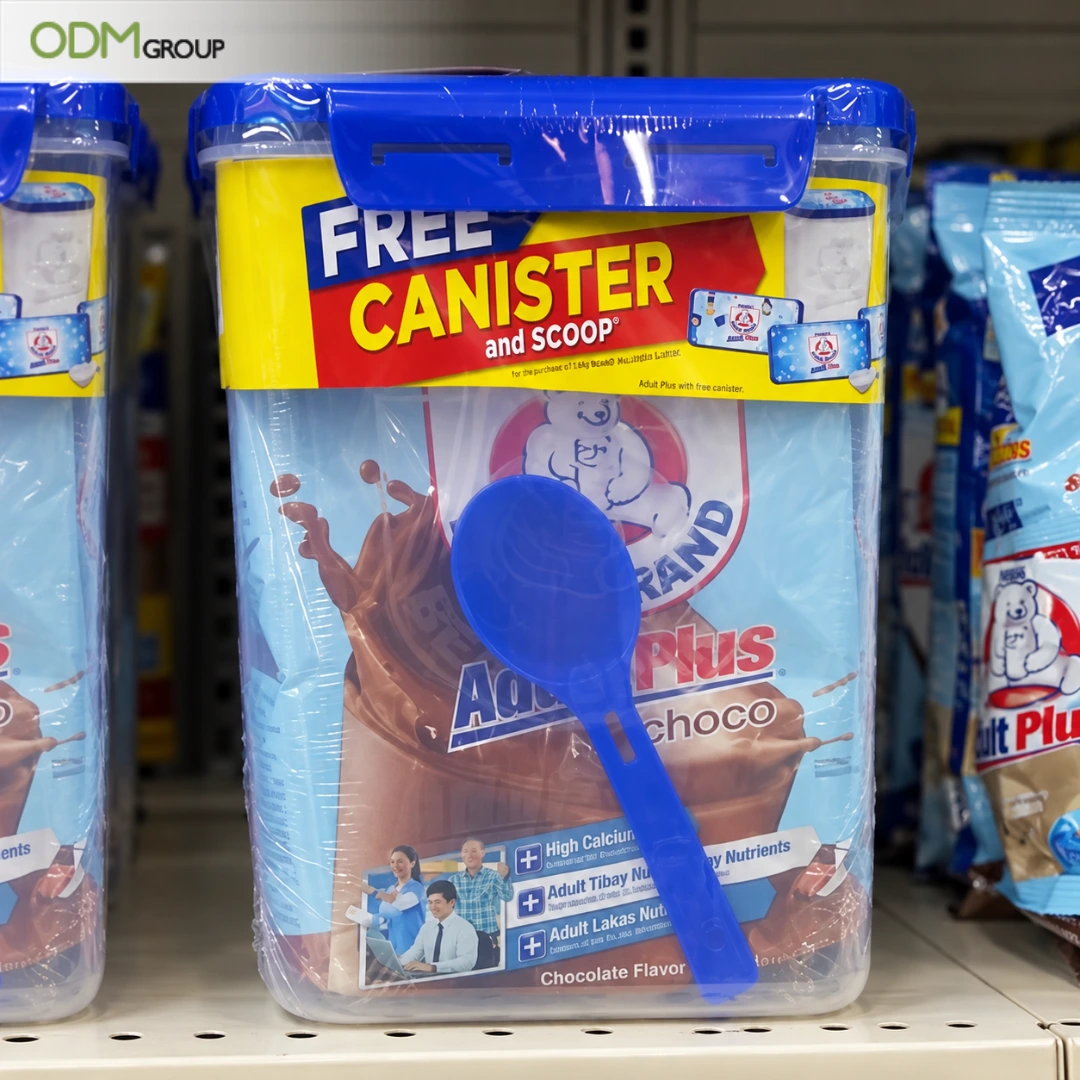
3. Bear Brand Food Container: Merchandise That Fits the Product Category
Another Nestlé example features a Bear Brand promotional food container. For food and beverage brands, household storage products can provide a natural connection between the core product and the giveaway.
This is particularly relevant when customers already use containers for food preparation, serving or storage. The design does not necessarily require an unusual shape or complicated mechanism.
A familiar product can be customised through its colour, branding, dimensions, lid construction and packaging. For campaigns involving several markets or product lines, brands may also explore whether a shared container design can accommodate different artwork.
Such an approach depends on manufacturing capability, order quantities and the approved specifications.
When evaluating these free promotional items, procurement teams should review material requirements, durability, closure performance, food-contact suitability and production consistency.
The Bear Brand example demonstrates that a simple product can be commercially relevant when it fits the customer’s intended use.
4. Nido Promotional Badge: A Compact Branded Giveaway
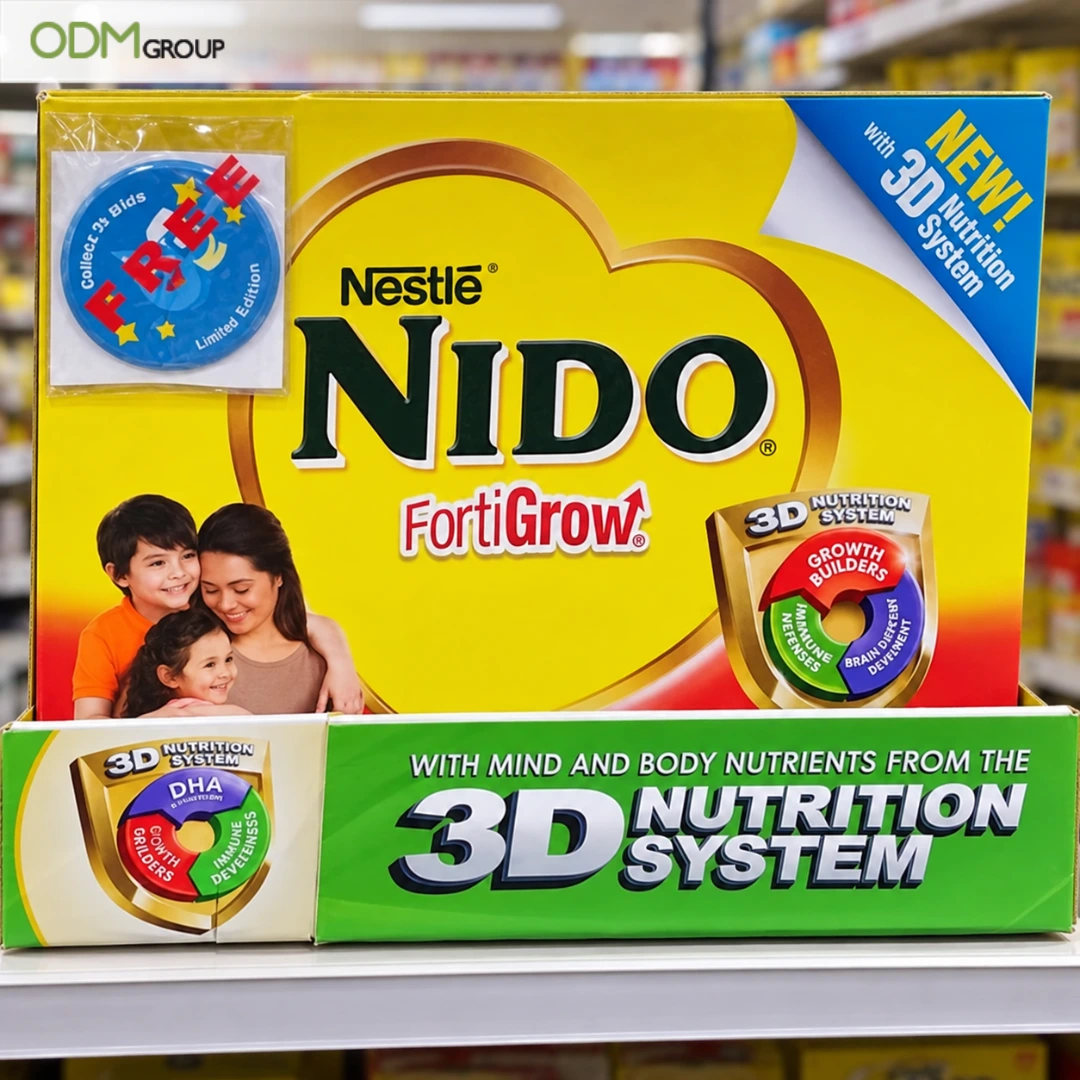
The final example features a Nido promotional badge.
Badges are smaller and less functionally complex than food containers, but they can still serve a defined campaign purpose.
They may be considered for themed promotions, event giveaways, collectible ranges or promotional packs.
Their compact size can make them easier to incorporate into certain distribution formats, although packaging, attachment methods and handling requirements still need review. Buyers should consider the material, dimensions, artwork reproduction, fastening system and intended user.
For products likely to be used by children, attachment components and other potential hazards require particular attention.
The Nido example highlights the importance of selecting free promotional items according to the campaign’s purpose and target audience, rather than relying solely on product size or unit price.
How to Choose Free Promotional Items for Retail Campaigns
The Nestlé examples show that promotional merchandise can serve several different purposes.
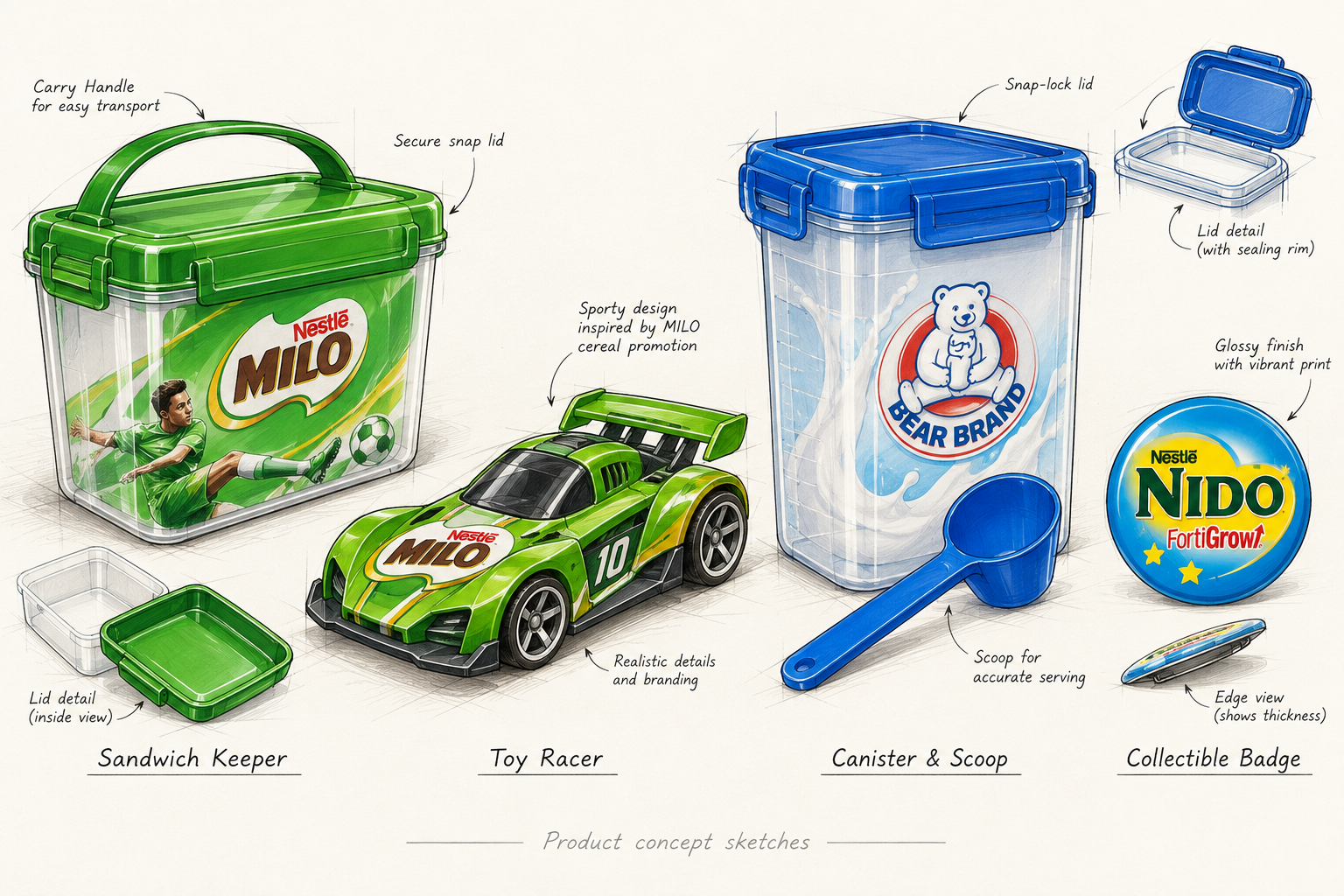
A food container offers everyday utility. A toy introduces a collectible element. A badge provides a compact branded item.
The right choice depends on the intended audience and campaign objective.
| Promotional item | Potential campaign role | Key production considerations |
|---|---|---|
| Branded food container | Practical household giveaway | Materials, food-contact suitability, closures and packaging |
| Collectible toy car | Themed or collectible incentive | Licensing, toy safety, tooling and promotional packaging |
| Promotional badge | Compact branded merchandise | Material, artwork, attachment and intended user |
| POS display | Retail visibility and promotion communication | Structural design, dimensions, assembly and replenishment |
Brands should also decide how the promotional item will be distributed.
An on-pack gift, a gift with purchase and a separately redeemed giveaway may require different packaging, inventory arrangements and customer instructions.
Clear promotional conditions are important, particularly when the gift is only available with selected products or subject to limited stock.
How ODM Group Can Support Custom Promotional Merchandise
Developing free promotional items involves more than selecting a product from a catalog. Brands need to consider design, materials, manufacturing, packaging and delivery requirements.
ODM Group supports the development of custom merchandise through product design, sampling, manufacturing coordination and quality control.
Design and Prototyping
The process begins with a clear product specification covering the target audience, intended use, dimensions, branding and budget.
Through prototyping, brands can review the product’s appearance and functionality before approving mass production.
Manufacturing and Quality Control
Factory selection and production planning depend on the merchandise category, customization requirements and order quantity.
Approved samples, specifications and quality checks help establish expectations for the finished products.
Packaging and Delivery
Free promotional items may need to be packed individually, attached to existing products or assembled into promotional sets.
Planning should account for packaging development, production, inspections, shipping, and the required retail launch date.
Coordinating these stages helps reduce avoidable problems when several promotional components must arrive together.
What Affects the Cost and MOQ of Free Promotional Items?
Minimum order quantities and unit costs vary according to the product and manufacturing process.
A printed badge will generally involve different production requirements from a custom-molded toy or food container.
Factors affecting quotations include:
- Product materials and dimensions
- Custom tooling or mould requirements
- Branding and decoration methods
- Order quantity
- Individual or retail-ready packaging
- Testing and compliance requirements
- Shipping and delivery arrangements
A lower unit price does not necessarily mean a lower overall campaign cost.
Buyers should compare quotations against the same approved specification and include relevant costs for samples, packaging, freight and distribution.
Lead times should also be confirmed before committing to a campaign launch date.
Lessons From Nestlé’s Promotional Merchandise Examples
The historical Nestlé campaigns demonstrate that free promotional items do not need to follow a single format.
Practical containers, collectible toys and compact branded merchandise can each support different promotional concepts.
What matters is the relationship between the giveaway, the audience and the purchasing occasion.
Brands should also consider how the promotional item will be presented in store, whether its packaging communicates the offer clearly and how the product will be manufactured and distributed.
By addressing these decisions early, marketing and procurement teams can develop merchandise that fits the wider campaign rather than treating the giveaway as an afterthought.
Planning a Free Promotional Item for Your Brand?
ODM Group can help brands explore custom promotional merchandise, from initial product concepts and sampling to manufacturing and packaging coordination.
If you are developing a gift-with-purchase campaign, on-pack promotion or branded giveaway, discuss your project with ODM Group.
More Ideas


Frequently Asked Questions
What are free promotional items?
Free promotional items are products provided to customers or campaign participants without a separate charge for the item, often as part of a purchase offer, event or marketing activity. Examples include branded containers, collectible toys, badges and other promotional merchandise.
What are the best free promotional items for retail campaigns?
The best products depend on the target audience, campaign objective and distribution method. Practical household merchandise, collectible products and compact branded giveaways can all be suitable when they are relevant to the promotion.
What is the difference between a free promotional item and a gift with purchase?
A free promotional item is a broad term for merchandise distributed as part of a marketing activity. A gift with purchase is a specific promotional arrangement in which customers receive an additional item after meeting purchase conditions.
Can free promotional items be included inside retail packaging?
Yes, depending on the merchandise, packaging design and applicable requirements. The item must be suitable for the intended distribution method, and any safety, packaging or product-contact considerations should be assessed.
What to Read Next?
Beer Swag Ideas: Lessons from Heineken Silver’s Taiwan Campaign
Beer swag is evolving beyond traditional bottle openers and [...]
Snack Bag Clips: A Gift With Purchase Idea Inspired by Hair Accessories
Snack bag clips do far more than simply reseal [...]

Freebie Marketing Strategy: A Winning Technique to Increase Sales
Freebie marketing strategy has become a prominent tool in [...]

How to Leverage Liquor Marketing Using a Promotional Dry Bag?
Traditionally recognized for their ability to safeguard personal belongings [...]

Fit Me Custom Reusable Containers: A Practical GWP Choice
The rising awareness of plastic pollution has spurred a [...]
CaloSure Customised Gift Set: The Power of On-Pack Gifting
Do you still remember the feeling of getting the [...]