
Are you looking for ways to bring your products to the forefront for your target audience? Get your merchandise into the spotlight with custom retail display tray ideas! Cost-effective and practical, they can give your sales a push!
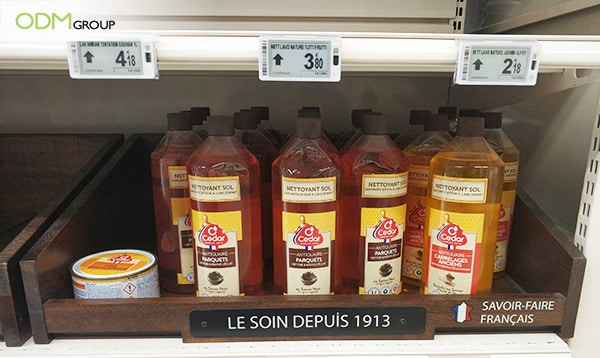
We’ve come across O’Cedar’s unique retail display in one of the stores we’ve visited in France. On the other hand, O’Cedar is a specialist in the cleaning and authentic care of delicate surfaces, established in 1913. Its on-shelf merchandising display is noticeable because of its practical mechanism.
As you would notice, O’Cedar is the only brand that utilizes a spring-loaded display in this particular retail shelving; thus, it really stands out among the rest of the products being sold.
Spring-Loaded Display vs Gravity-Loaded Racks: What are the Differences?
Retail display tray ideas such as spring-loaded and gravity-loaded displays are innovative ways to automatically push your goods on your shelf to the front each time a customer retrieves one. Both have unique mechanisms that make each one different from the other.
Spring Loaded Display
Many stores, particularly retail stores, use spring-loaded displays for their products. It allows customers to easily select and remove one or more items from the shelves. Such displays are installed on racks or retail display trays.
Shelves are typically provided with a forward-feeding pusher device. The pusher forces the remaining products to be pushed forward when one of the products from the front end of the shelf is removed.
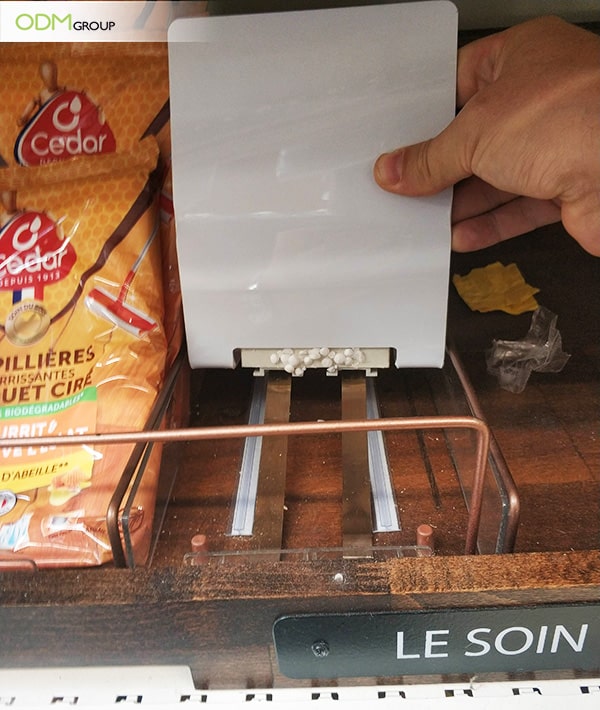
Retail Display Tray
A spring-loaded display consists of three parts: a pusher, a divider, and T-rails. This innovative in-store display is typically made of acrylic, metal, and wood.
Here’s how this innovative in-store display works:
Advantages:
Once customers pick items from the display, the pusher will push forward the remaining products from the back, allowing the next customers to access the products easily. Likewise, trays can be easily moved and locked back. This retail display tray’s mechanism allows staff to quickly refill or load the POS when goods run out of stock.
Disadvantages:
Spring-loaded displays are not ideal for loading with heavy merchandise. Moreover, there are items or packaging that resist sliding, meaning they are not suitable to be stored in this kind of retail display tray.
Here’s another perfect example of a spring-loaded point-of-sale display.
This POS retail display keeps merchandise front-facing, making product displays look tidy and well-stocked. It is also great for storage and maintaining good merchandising practices. This innovative POS is very suitable for canned goods or beverages.
Gravity Loaded Rack
This type of retail display has the same purpose as the spring-loaded pusher. This system keeps the goods at the front, so your display looks neat and well-stocked. This is commonly used for canned beverages and other retail merchandise. This system is equipped with sliding beads that cause the products to roll forward.
Advantages:
Gravity-fed retail displays can be used effectively on shelves and at checkout counters in big-box retail, grocery stores, and more. These systems are ideal for facing large, heavy, or bulky items that may be difficult to advance using a pusher. Gravity front-feeding also makes out-of-stock conditions immediately detectable and simplifies stock replenishment, whether filling from the front or rear, helping reduce labor costs.
Disadvantages:
Gravity-loaded display only relies on the shelf angle or a shelf riser to allow products to glide effortlessly down a sloped surface. It means that this retail display isn’t ideal for flat shelving since the product won’t slide on it.
This retail display design works similarly to this:
They are commonly installed in a sloped position, allowing products to glide or roll easily in front of the display.
Perks of Using Retail Display Trays
Enhance the appearance of your retail store shelves with these custom retail display tray ideas. Here are the advantages of using them in your promotion!
Retail Display Tray
-
Reduce merchandising labor
Good sales associates are your most valuable resource in today’s busy retail markets. Allow them to spend more time serving your customers rather than straightening out merchandise on your shelves. Thus, using such automatic displays can help you maximize your employees while maintaining your products on the shelf.
-
Decrease product shrink
Products that get stuck on the back of the shelf cost you money. Spring-loaded and gravity-loaded displays avoid products getting lost at the back of the shelf. Furthermore, their unique design greatly facilitates the rotation of perishable products by consistently presenting the goods you wish your customers to buy.
-
Enhance accessibility
Imagine a shelf without spring-loaded or gravity-loaded trays. It’s hard for customers to access specific items stocked at the back of the displays. The fact that retail staff are not always around to assist them might frustrate and stress them out. Moreover, it’s hard for merchandisers to do inventory and refill the shelf when products run out of stock.
-
Improve category and maximize shelf space
Eliminate dead spots along the aisle and fill them with products your customer will buy. These display ideas are a product-facing solution that maximizes product visibility and accessibility while maximizing merchandising space. Utilizing these retail shelving displays will absolutely increase category size by 15-20% on average.
How ODM Supports Custom Retail Display Development
ODM works with brands to develop retail displays that balance product presentation, structural performance, branding, cost, and retail practicality.
Our process can include concept development, sketching, 3D CAD, and prototyping. We can also coordinate factory selection, production management, on-site quality control, and international logistics.
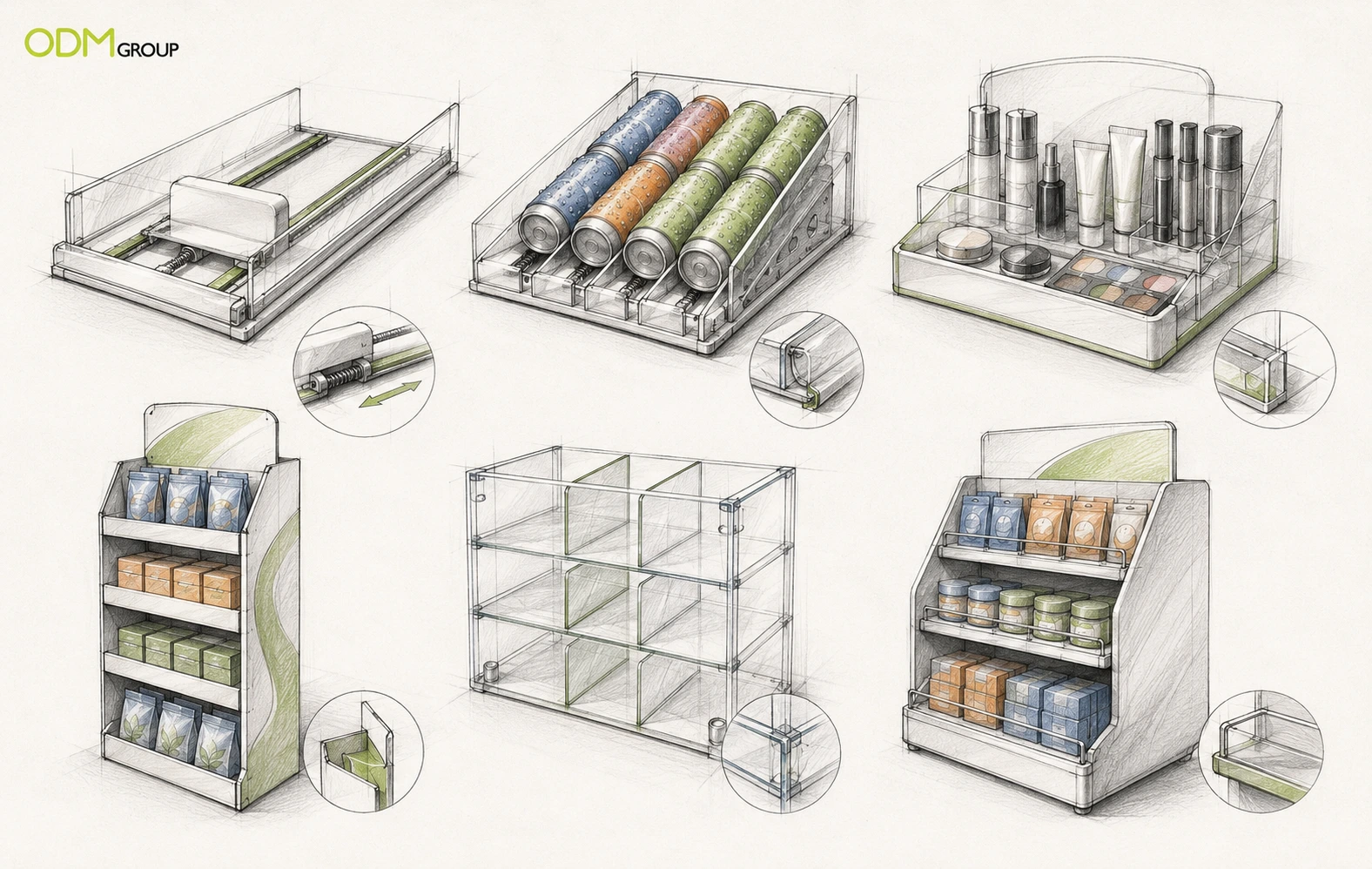
For spring-loaded and gravity-fed trays, our team considers how the product moves through the system—not simply how the display looks. We can assess packaging dimensions, weight, friction, stability, shelf limitations, loading methods, and branding visibility before the project moves into full production.
This integrated approach helps brands identify potential problems early and develop a display that is practical for retailers and appealing to customers
Final Thoughts
Spring-loaded and gravity-fed retail display trays can both help brands maintain better-organized, more accessible, and more visible shelf presentations. The best system depends on the product and the environment in which it will be displayed.
A successful display should make shopping easier, support efficient replenishment, and reinforce the brand without creating additional work for retail employees.
Do you have a product that needs a stronger in-store presentation? Contact ODM to discuss a custom retail display tray. Our team can help transform your initial idea into a tested, retail-ready display solution.
More Display Ideas


Frequently Asked Questions
What is a retail display tray?
A retail display tray is a merchandising unit that organizes and presents products on a shelf or counter. Some trays include spring-loaded or gravity-fed mechanisms that automatically move products forward.
What products can be placed in a retail display tray?
Display trays can be developed for beverages, cosmetics, packaged food, household products, personal care items, pharmaceutical products, and many other types of retail merchandise.
What is the difference between spring-loaded and gravity-fed displays?
A spring-loaded display uses a pusher to move products forward. A gravity-fed display uses an angled track that allows products to slide or roll toward the front.
Can retail display trays be customized?
Yes. Brands can customize the dimensions, number of lanes, materials, feeding mechanism, colors, graphics, headers, front panels, and loading method.
Related Blogs:
11 Secrets of Successful Visual Merchandising Displays
Does having great products automatically attract customers? Not always. [...]
Creative LED POP Signage Ideas for In-Store Promotions
In a busy retail aisle, shoppers do not always [...]
Shine Brighter, Sell Better: Top 4 Benefits of LED On-Shelf Display
The retail store shelf can be just as plain [...]

4 Secrets to An Impressive Seasonal Merchandising Display
Seasons come and go, much like anticipated holidays. However, [...]
Top 4 Things to Consider For An Effective Beer Merchandising Display
A retail market is a competitive place. Not only [...]

POS Display: 6 Things To Learn From Carnex Custom Display Design
A custom display design manages to get people's attention [...]
Reach out to our team to get a quote for this beverage rack display designed by our product designers at Mindsparkz.