
Retail environments are crowded. Shoppers encounter hundreds of products, signs, promotions, and competing brand messages during a single store visit. An attractive product alone may not be enough to capture attention.
An acrylic free-standing display gives a brand its own dedicated space on the retail floor. Unlike conventional shelving, it can be customized around the product, campaign, brand identity, and customer journey.
A well-designed display does more than hold merchandise. It increases product visibility, makes the range easier to explore, communicates a clear brand message, and can encourage impulse purchases at the point of sale.
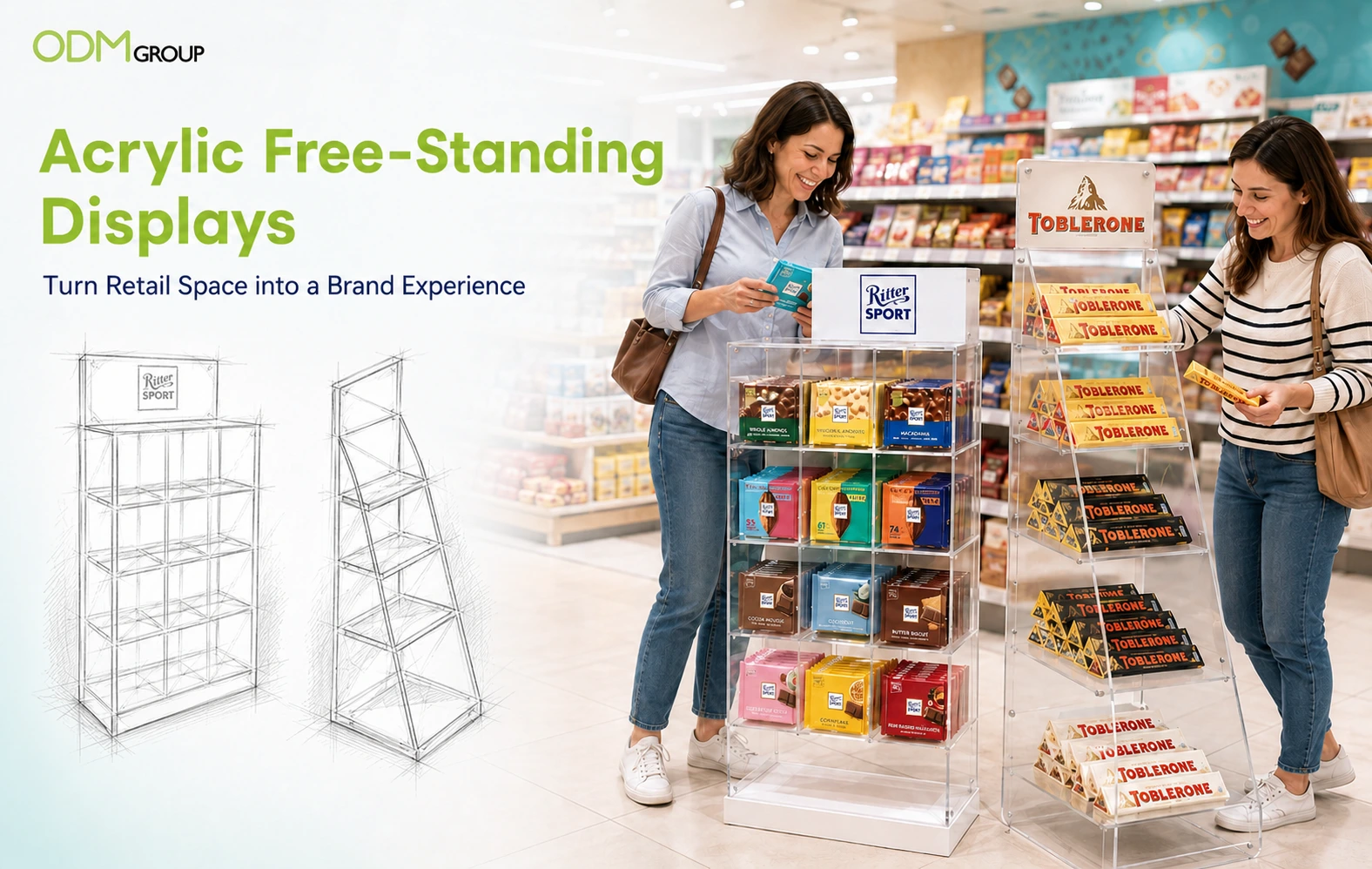
Ritter Sport wowed their customers with their collection of chocolates showcased in a simple acrylic free standing display. Free standing displays are an effective way of increasing your visibility within hectic retail stores. They are standalone shelves usually placed along grocery store aisles. What they do is separate your products from competitor brands to make them stand out with this advertising acrylic display. This way, your products you get the spotlight and your customers’ undivided attention.
Ritter Sport’s acrylic marketing display is simple, yet all the elements of good design are there. Below, we share with you what makes this a good POS display design idea.
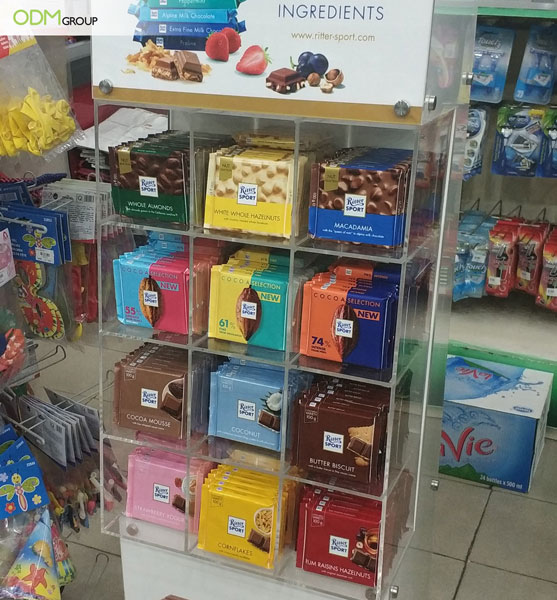
Acrylic Free Standing Display
What Is an Acrylic Free-Standing Display?
An acrylic free-standing display is a standalone retail fixture made entirely or partly from acrylic. It is also commonly described as a free-standing display unit, or FSDU.
These displays can be positioned away from permanent store shelving, subject to retailer approval. They are often placed near aisle entrances, checkout areas, promotional zones, product launches, or complementary categories.
A custom display may include:
- Product shelves or compartments
- Transparent, colored, or frosted acrylic panels
- A branded header
- Printed side and base panels
- Product information
- Price holders
- Replaceable graphics
- LED lighting
- Lockable cabinets
- Wheels or adjustable feet
- Flat-pack or modular components
Acrylic FSDUs can be designed for cosmetics, confectionery, electronics accessories, beverages, personal-care products, stationery, collectibles, and many other retail categories.
How to Create a Stronger Retail Presence Using an Acrylic Free-Standing Display
1. Give the Product Dedicated Retail Space
One of the greatest advantages of a free-standing display is that it separates a product from competing merchandise.
On a conventional shelf, a brand must compete for attention within a fixed layout. Packaging may be partially obstructed, shelf facings may be limited, and promotional messages can disappear among neighboring products.
A custom FSDU gives the brand greater control over how its products are presented. The display can organize a complete range, highlight a new launch, introduce a seasonal promotion, or feature selected bestsellers.
Dedicated space can also make the range easier to understand. Products can be grouped by flavor, size, function, color, or price point, helping shoppers compare options and make decisions more quickly.
The display should answer three questions at a glance:
- What is the product?
- Why should the shopper be interested?
- What should the shopper do next?
If these answers are not immediately clear, the display may need a stronger visual hierarchy.
2. Keep Products Visible and Accessible
Acrylic is popular in retail because it offers a clean appearance without unnecessarily obstructing the merchandise.
Transparent shelves and panels allow shoppers to see products from different angles. They can also reduce the visual weight of the structure, enabling colorful or distinctive packaging to become the focus.
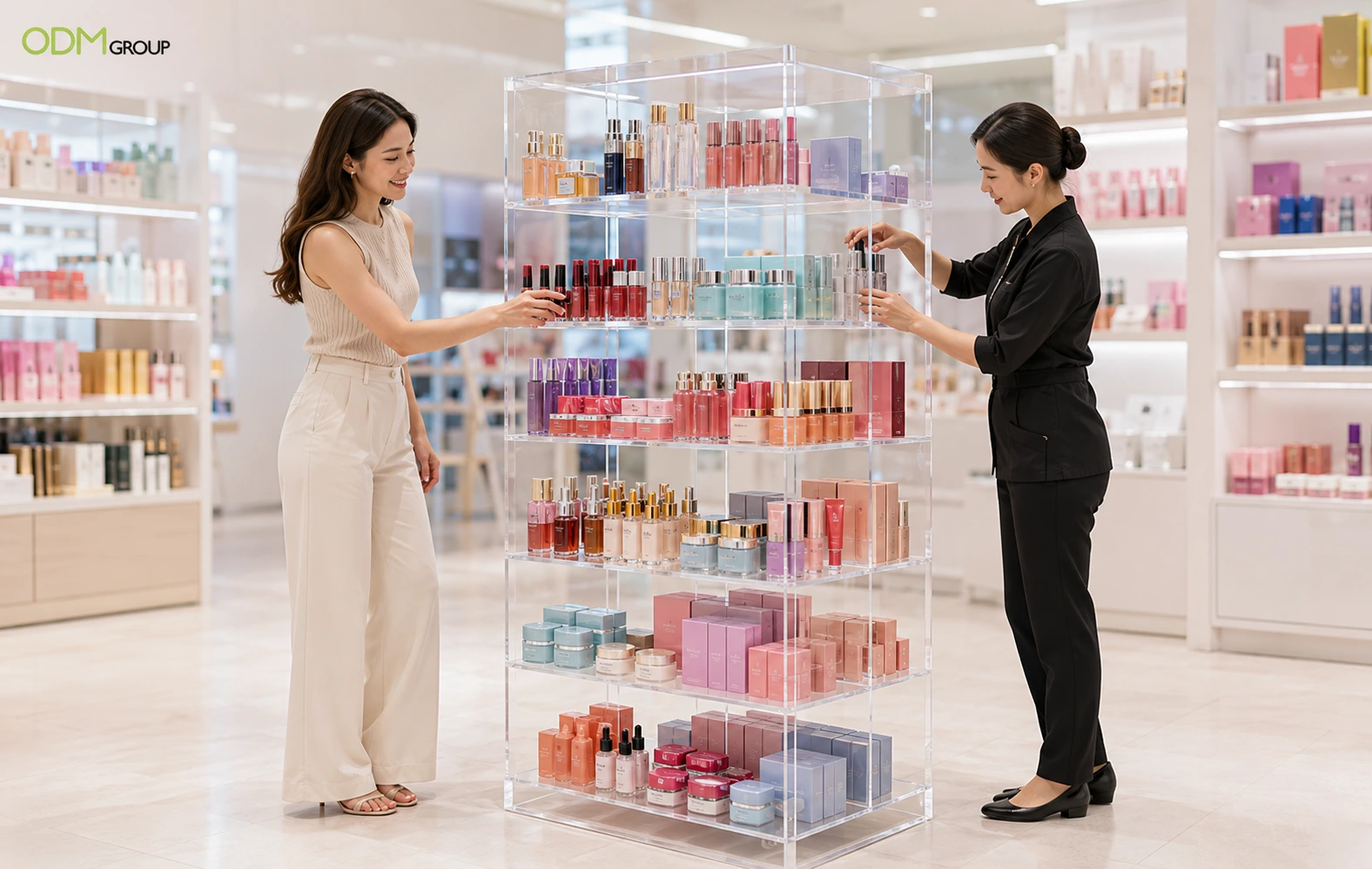
Visibility alone is not enough. Shoppers must also be able to reach, remove, and return products comfortably.
Designers should consider:
- The height of each shelf
- Shelf depth and spacing
- Product orientation
- Accessibility from different sides
- The amount of force needed to remove an item
- Visibility when stock levels become low
- Ease of replenishment for store employees
The products themselves should be tested inside a physical prototype. A shelf that appears suitable in a rendering may be too tight, too deep, or difficult to restock in practice.
3. Build Brand Recognition from a Distance
An effective display should work at several viewing distances.
From across the store, the shopper should be able to recognize the brand or product category. From a few steps away, the campaign message and product benefits should become clear. At close range, shoppers should be able to browse the assortment and read detailed information.
Branding can be incorporated through:
- A logo or branded header
- Printed base and side panels
- Brand colors
- Product photography
- Short campaign messages
- Dimensional logos
- Laser-cut elements
- Lighting
- Promotional price information
- QR codes or interactive features
The key is to create a clear hierarchy. A display overloaded with messages can be difficult to understand, particularly in a busy store.
Headlines should be concise and readable. Product claims should be relevant and properly substantiated. Any call to action—such as “Discover the Range,” “Try It Today,” or “Choose Your Favorite”—should be simple and direct.
4. Design the Structure Around the Product
Every display should be designed using accurate product dimensions and weights.
Generic shelf sizes may waste space or create a poorly organized presentation. Custom-sized compartments can keep packs aligned, improve stock density, and help prevent smaller items from falling over or becoming hidden.
The design brief should include:
- Individual product dimensions
- Product weight
- Number of SKUs
- Desired stock capacity
- Preferred product orientation
- Packaging variations
- Restocking method
- Target display footprint
- Retailer height restrictions
- Required load capacity
Additional components may be needed depending on the product. These can include dividers, product pushers, hooks, rails, price strips, raised edges, or removable trays.
Structural stability is especially important for tall or narrow displays. The base must support the unit when it is fully stocked, partially stocked, and being used by shoppers. Designers should also consider how the display behaves if products are removed unevenly.
5. Select Materials for Performance and Cost
Acrylic can be cut, bent, polished, printed, engraved, bonded, and combined with other materials. It can produce a premium-looking display while remaining lighter and more resistant to breakage than glass.
However, acrylic is not the best solution for every component or campaign.
The material can scratch if handled or cleaned incorrectly. Large displays may require additional reinforcement, and heavy products may need thicker shelves or a supporting metal structure. In some cases, a mixed-material display provides a better balance of appearance, strength, weight, and cost.
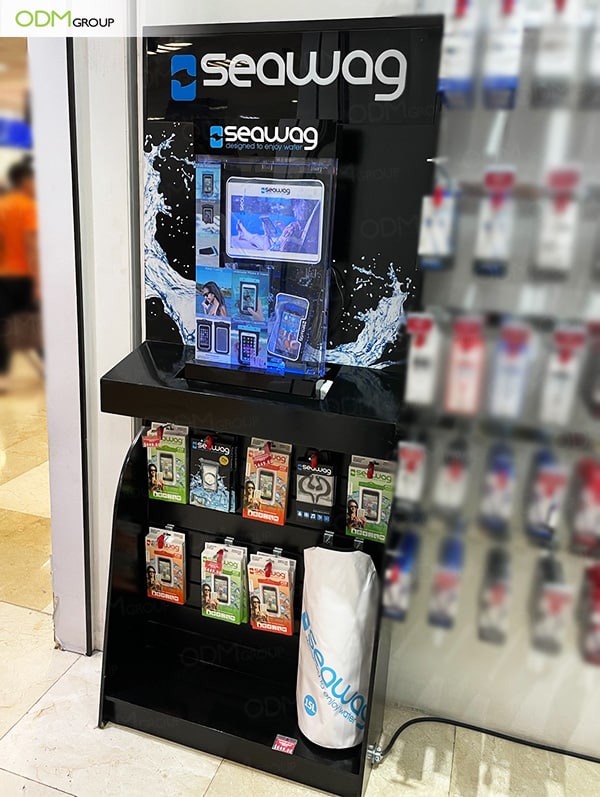
Possible materials include:
- Clear, colored, or frosted acrylic
- PETG
- Polycarbonate
- Metal
- Wood or MDF
- Corrugated board
- PVC foam board
- Printed plastic panels
- Tempered glass
Material selection should be based on the display’s intended use—not appearance alone.
Important considerations include:
- Product weight
- Campaign duration
- Number of retail locations
- Indoor or outdoor placement
- Expected shopper interaction
- Cleaning requirements
- Production quantity
- Target cost
- Shipping method
- Sustainability objectives
For a short promotional campaign, a lightweight or partly recyclable structure may be more appropriate. For a long-term retail installation, a durable frame with replaceable graphics may provide better value.
6. Design for the Retail Environment
A display does not operate in isolation. Its performance depends heavily on where and how it is installed.
Before design work begins, brands should confirm the retailer’s requirements. These may cover maximum dimensions, approved materials, fire safety, stability, accessibility, electrical components, assembly, and placement.
The intended location will also influence the design.
A display positioned against a wall may need branding on only three sides. A display placed in an open promotional area should work from every viewing angle. A checkout display may require a small footprint, while an aisle display must allow sufficient room for customer movement.
The design team should assess:
- Available floor space
- Shopper traffic direction
- Lines of sight
- Nearby fixtures
- Competing visual messages
- Restocking access
- Electrical access, if required
- Store safety requirements
- Assembly time
- Planned campaign duration
Successful retail design balances visibility with practicality. A display must attract shoppers without obstructing the store or creating operational problems for employees.
7. Plan Production and Logistics from the Beginning
A display concept must be manufacturable, repeatable, and economical to deliver.
Complex curves, thick acrylic, polished edges, printed components, lighting, and custom fittings can create an impressive result, but they also affect production time and cost. Early engineering input can help simplify the structure without weakening the concept.
Logistics should also influence the design. Fully assembled displays may be convenient for store teams but expensive to ship. Flat-packed or modular units can reduce freight volume, although they require clear instructions and reliable assembly.
How ODM Supports Acrylic Display Projects
Developing a custom retail display requires coordination across design, manufacturing, quality control, and delivery. ODM Group can help manage the process from initial concept to final shipment.
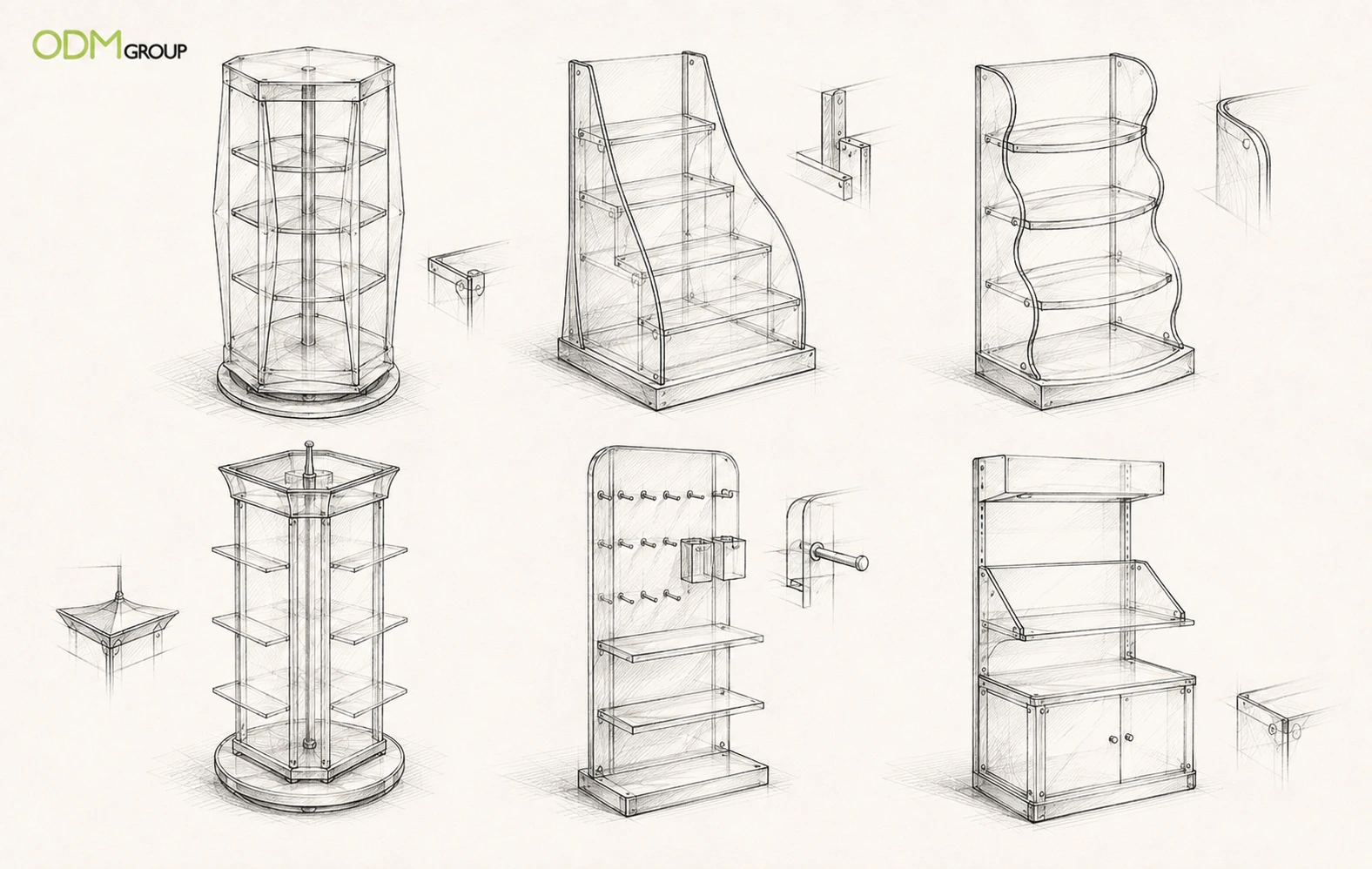
Our services include:
- Concept sketches: Translating your product requirements, branding, budget, and retail objectives into an initial display idea.
- Prototyping: Producing a sample to test product fit, appearance, stability, accessibility, and assembly before mass production.
- Factory selection: Identifying a suitable manufacturer based on materials, technical capabilities, quantity, quality requirements, and lead time.
- Quality control: Inspecting materials, dimensions, printing, finishing, structure, functionality, and packaging against approved specifications.
- Packaging and logistics: Coordinating protective packaging, shipping preparation, and delivery to your warehouse or chosen destination.
Related Blogs
Acrylic displays allow you to promote your products in an eye-catching way without compromising transparency. It is a cost-effective alternative to glass, making it great for both indoor and outdoor marketing.
There are so many types of signage out there. But it always pays to be a little different sometimes. Take a look at this unconventional promotional signage from Globe:
Hangsell displays are a great way to maximize limited shelf space and drive impulse purchases at the point of sale:
Heineken’s acrylic menu stand can be summed up in two words: “simple” and “effective.” Here’s why:
When it comes to plastic manufacturing, you have lots of options. Find out the difference between acrylic and polycarbonate in this blog.
Are you looking for POS display inspiration? Here’s a simple yet very meaningful freestanding signage by Haagen Dazs.
ODM Services

Branded Souvenir Gifts for Events and Exhibitions

Branded Sobriety Gifts: From Concept to Scalable Products

Custom Slim Twist Pen Program for Lyford Cay Club
Frequently Asked Questions (FAQ):
What is an FSDU display?
A free-standing display unit (FSDU) is a type of flexible retail display that’s dedicated to highlighting key products, typically in retail environments.
How do I create the best FSDU display?
FSDU displays need to be attractive and eye-catching in order for your customers to be interested in your products. This can be done through the use of materials like cardboard where colours can be easily printed.
What are some common materials used for a FSDU display?
Some common materials include cardboard and acrylic. These are commonly used materials for an FSDU display with it being made of affordable materials.
Latest Blogs

Customized Cluster Bells: Inspiring Promotional Gift Ideas for Baby Brands
Customized Cluster Bells offer an interesting example of how [...]

Airplane Promotional Products: How STARLUX Airlines and CITY PRIMA Engage Customers
Airplane promotional products can do more than display a brand [...]
Event Branding Ideas: Make Every Touchpoint a Brand Experience
Event branding ideas turn separate venue elements into one [...]

Waterproof Camping Blanket: Take Your Brand Into the Outdoors
A waterproof camping blanket gives brands a useful role [...]

Custom Letter Envelope Opener Ideas for Corporate Gifts
A letter envelope opener may be a simple desk [...]

LED Screen Backpack: Smart Walking Billboards for Campaigns
Static outdoor signage and traditional promotional merchandise [...]