
A promotional canvas bag can give customers a useful reason to buy while carrying the brand beyond the store. When the bag is designed around a clear audience and campaign objective, it can support a gift-with-purchase, purchase-with-purchase, retail activation, event, or loyalty program.
One example observed by ODM involved Corona offering customers a branded canvas bag at a discounted price after they reached a qualifying spend. The campaign combined a useful lifestyle product with point-of-sale communication, a promotional contest, and a QR code. Although that specific promotion has ended, it offers relevant lessons for brands planning their own custom bag campaign.
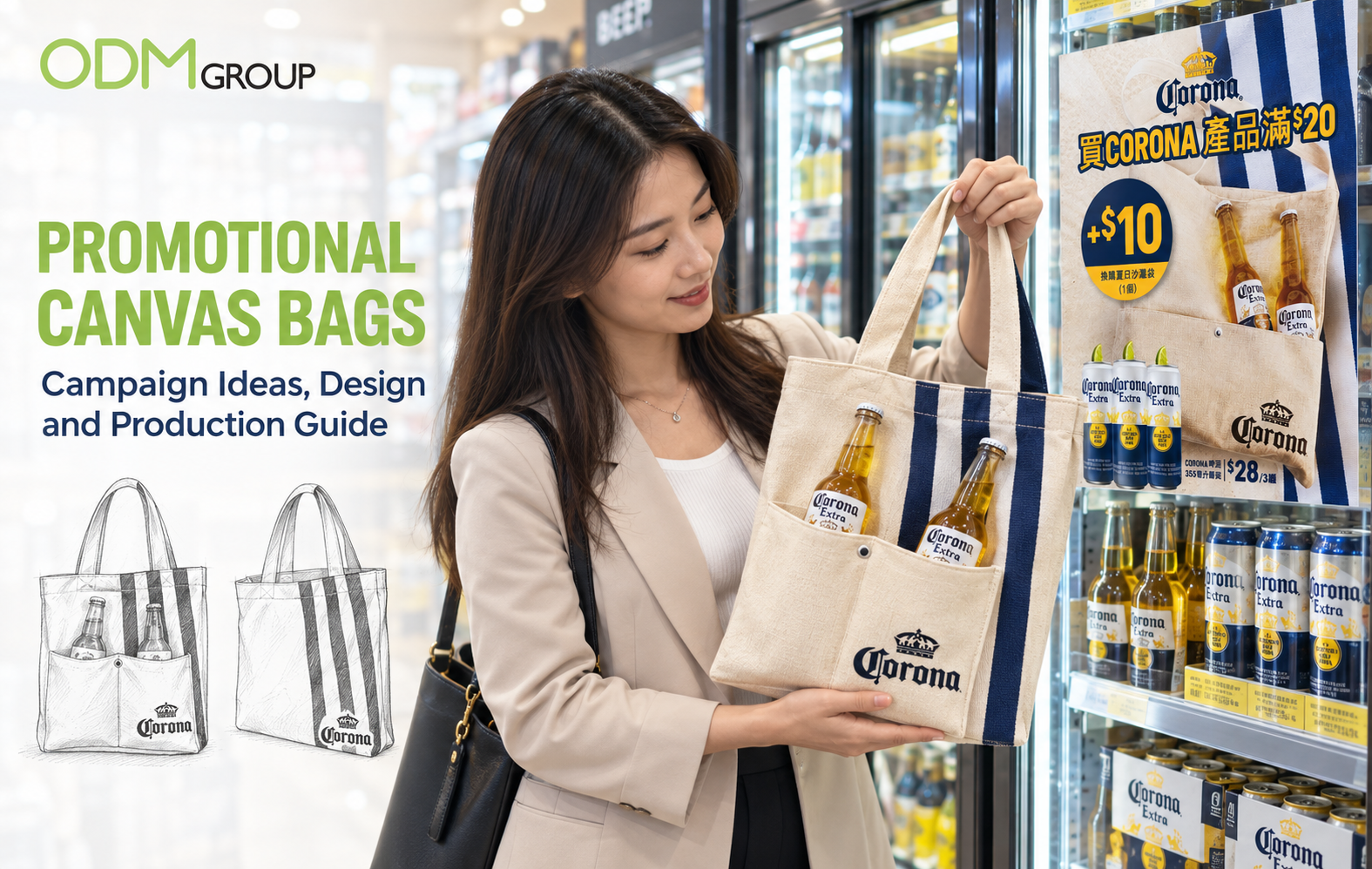
Campaign note: This article reviews a retail promotion observed by ODM. Corona is referenced as an independent case example. The featured campaign has ended and is not presented as an active offer or an ODM-produced project.
How the Corona Canvas Bag Promotion Worked
Corona promoted the bag through posters placed on the doors of refrigerated drink displays. This location connected the offer directly with the products customers were already considering.
Customers who spent the required amount could purchase the branded canvas bag at a reduced price. This is a purchase-with-purchase promotion, or PWP, rather than a completely free giveaway. It can help a brand offset part of the merchandise cost while increasing the customer’s basket value.
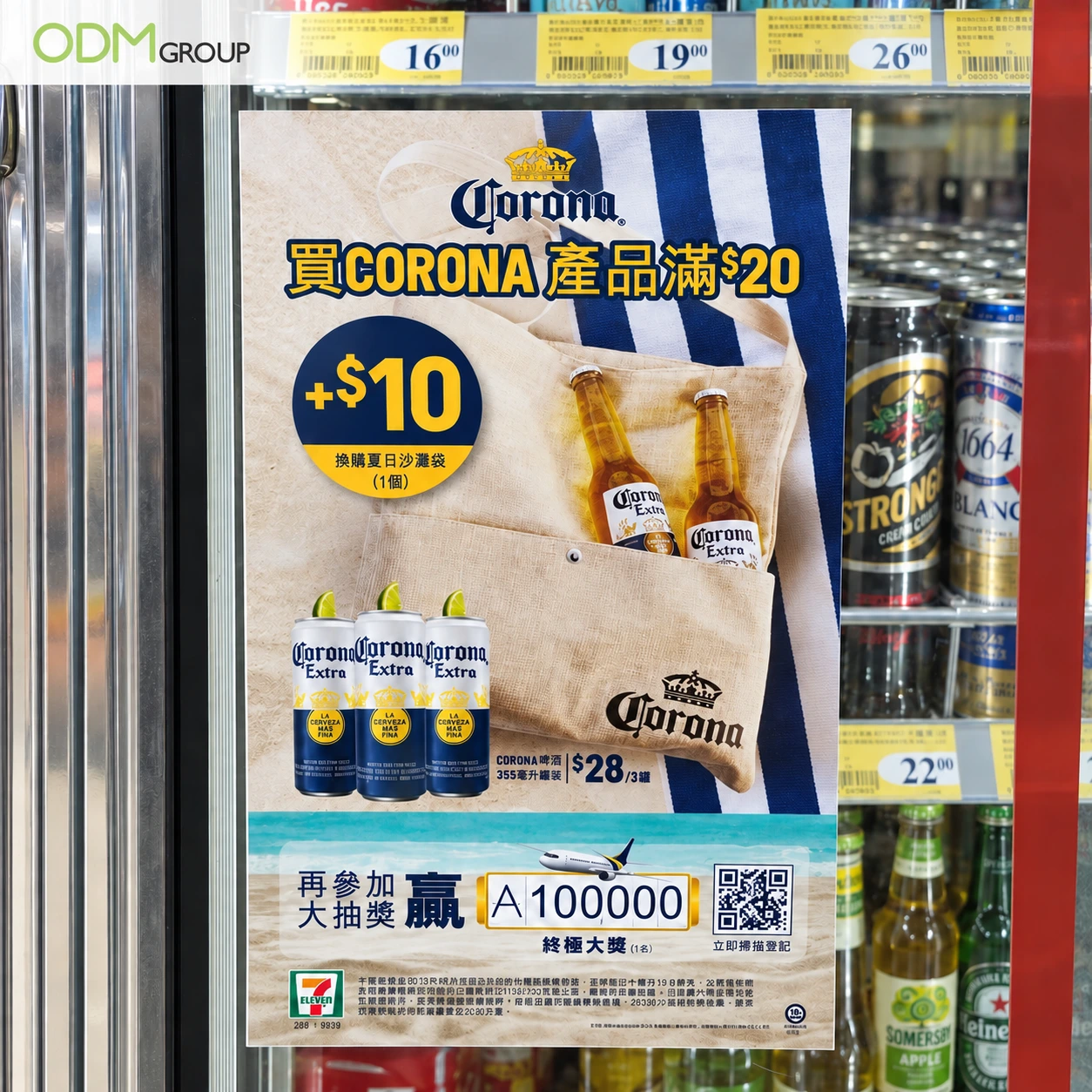
The campaign also advertised selected drinks, included a QR code for additional information and promoted a contest offering Asia Miles. These elements gave the shopper several reasons to engage:
- An immediate product offer
- A useful branded item
- A reason to spend more
- A digital route to further campaign information
- An additional contest incentive
The strongest aspect was the connection between the product, retail placement and summer lifestyle positioning. The bag did not appear as an unrelated giveaway. Its natural canvas body, blue-and-yellow branding and practical pockets supported Corona’s relaxed, outdoor-oriented campaign image.
Why Promotional Canvas Bags Work for Brand Campaigns
1. They offer visible value at the point of purchase
A well-designed bag is easy for shoppers to understand. Customers can quickly see its size, style and likely use. This immediate perceived value makes bags suitable for supermarket promotions, duty-free programs, pop-up activations and seasonal retail campaigns.
The offer still needs the right threshold. If the qualifying spend is too high for the bag’s perceived value, participation may be weak. If it is too low, the campaign may not support the desired sales uplift or budget.
2. They can extend brand visibility beyond the promotion
A bag continues to display the brand when it is used for shopping, commuting, travel, work, or leisure. However, logo exposure should not be the only design goal. People are more likely to reuse a bag that looks attractive, feels comfortable, and performs a clear function.
This is why subtle branding, useful pockets, suitable proportions, and a desirable color palette can be more effective than simply printing the largest possible logo.
3. They suit many campaign structures
Promotional canvas bags can support different sales mechanics. Brands deciding between a free premium and a discounted add-on can first compare ODM’s gift-with-purchase campaign ideas with the PWP approach used in this Corona example.
They can be used as:
- A gift with purchase above a minimum spend
- A discounted purchase-with-purchase item
- An on-pack promotion or multi-buy reward
- A loyalty-program redemption gift
- A new-member or subscription welcome gift
- Event merchandise or a conference welcome bag
- A seasonal retail collectible
- An employee or client gift
Brands should select the campaign mechanic before finalizing the product. The quantity, packaging, retail display, redemption process and delivery plan all depend on how customers will receive the bag.
Which Businesses Can Use a Custom Canvas Bag?
Beverage and FMCG brands
Beverage companies can connect canvas bags with summer promotions, multipack offers, festivals, picnics, or beach campaigns. Bottle dividers, exterior pockets or an insulated internal section can make the product more relevant to the category.
Any feature designed to hold bottles or heavier products must be properly engineered and tested. Pocket dimensions, seam strength, balance and handle attachment all affect real-world performance.
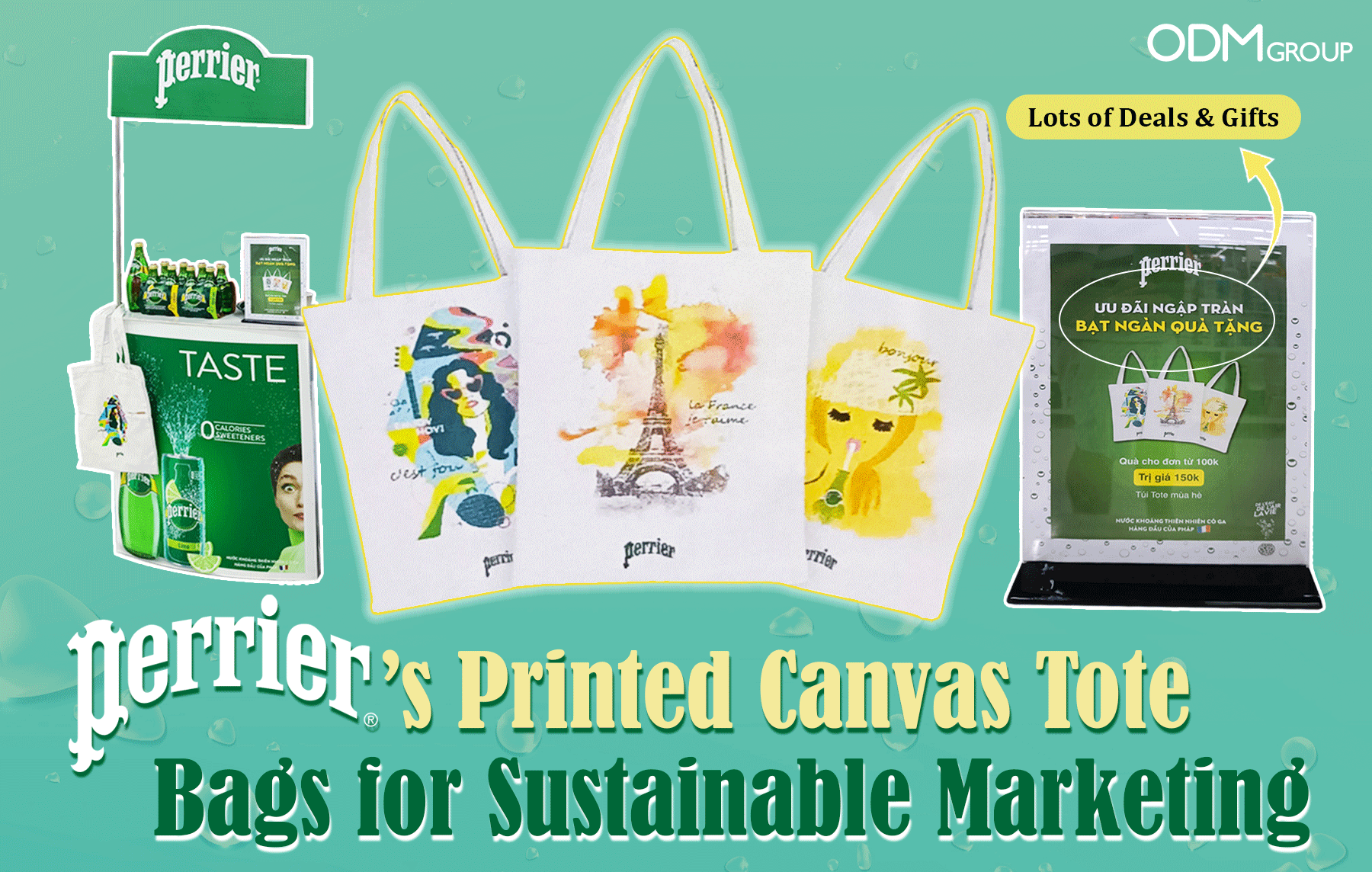
We see the brand’s custom-designed tote bags in one of the stores we visited in Vietnam. For every purchase worth 100k VND, customers can get any of these bags for free!
Beauty and wellness brands
Cosmetics, skincare and wellness companies can create cleaner, more premium versions with internal pockets, zipped sections, contrasting linings or removable pouches. These bags can accompany product bundles, seasonal gift sets, new-customer programs or spa memberships.
Travel, hospitality and tourism brands
Hotels, resorts, airlines and tourism boards can adapt the format into a beach tote, welcome bag or lightweight day bag. Useful additions include a secure closure, wet-item pocket, key loop, luggage sleeve or internal organizer.
Events, education and corporate programs
For conferences, universities and employee programs, the bag can organize documents, merchandise and daily essentials. A structured base, reinforced handles and internal compartments can improve use after the event.
Retailers and supermarkets
Retailers can use a series of different colors or graphics to create collectability. A bag can also support spending thresholds, loyalty points or limited seasonal drops. The design should feel desirable on its own—not like disposable advertising.
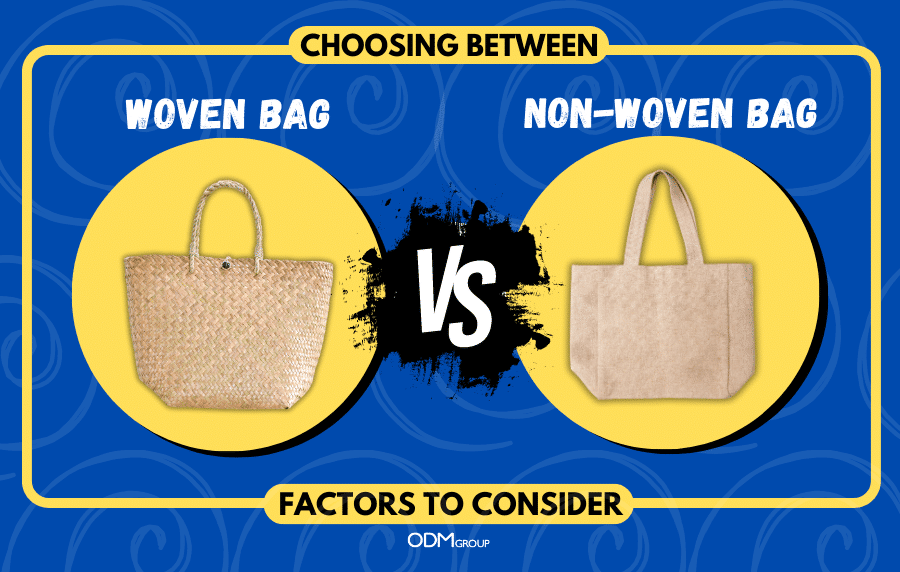
Carrefour is talking about replacing plastic bags by introducing custom eco-friendly tote bags as part of its sustainability commitment. Instead of a one-size-fits-all solution, the brand offers three practical options: a woven plastic bag, a foldable canvas bag, and a heavy-duty juco bag.
What Should Brands Decide Before Designing the Bag?
Begin with the campaign rather than the catalog. A useful product brief should answer these questions:
- Who will receive the bag?
- What action should the promotion encourage?
- Where and how will customers redeem it?
- What will they carry in it?
- What quantity and target cost are required?
- Which markets will receive the product?
- When must finished goods arrive?
- Does the bag need individual packaging, retail display support or barcode labeling?
- Which brand assets and mandatory messages must appear?
- How will campaign performance be measured?
These answers guide the size, material, construction, branding and production plan.
Canvas Bag Design and Material Options
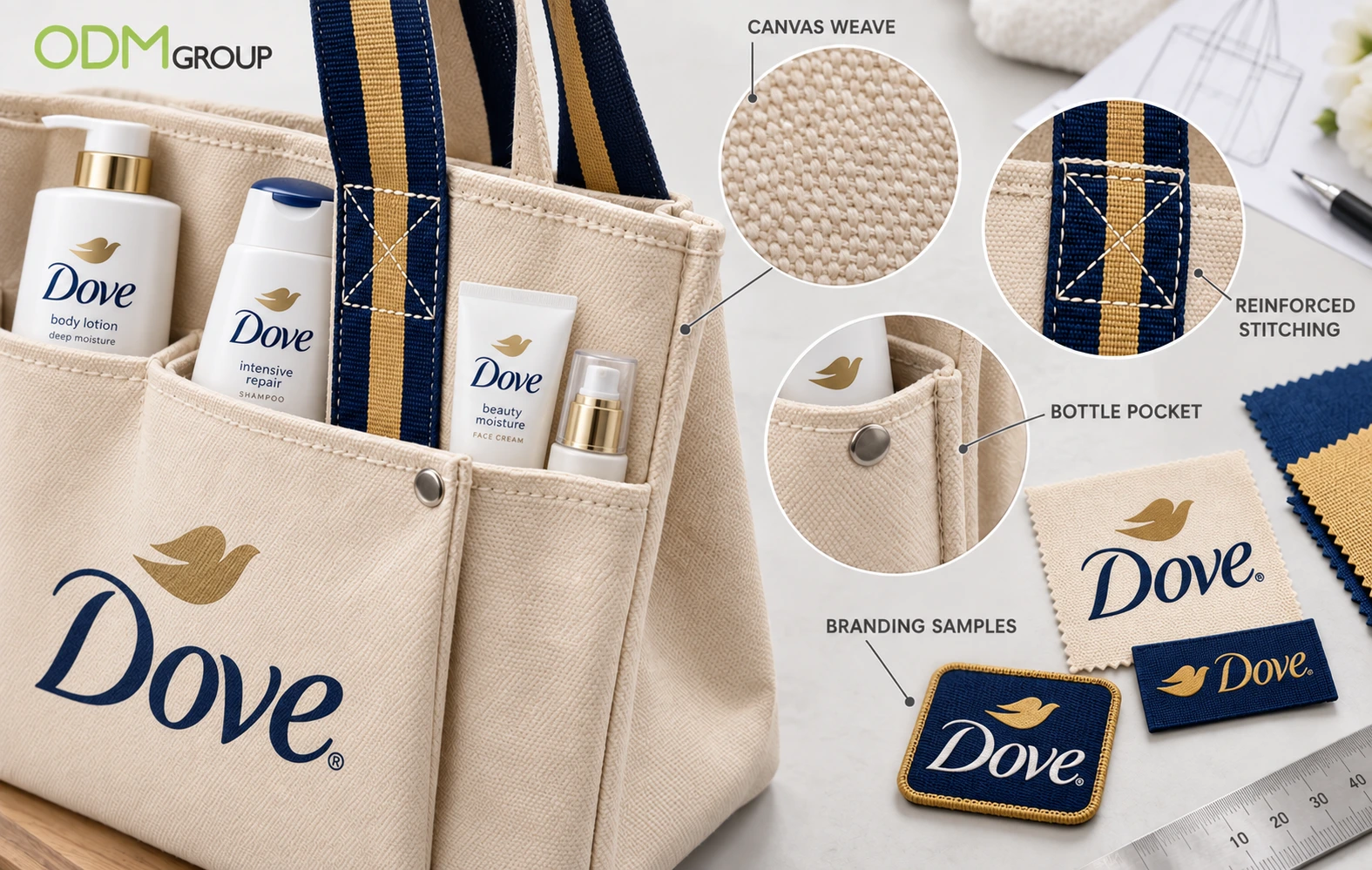
“Canvas” describes a woven fabric construction, but buyers still need to specify the fiber composition and performance requirements. Options may include conventional cotton, recycled cotton blends, certified organic cotton, or cotton blended with other fibers. Availability, color consistency, print performance, durability, certification and price will vary.
Fabric weight
Fabric weight affects structure, durability, printing, and shipping volume. A lighter canvas may suit a simple event giveaway, while a heavier fabric can create a more substantial retail or travel bag. The correct choice depends on the intended load and target positioning.
Do not approve fabric by weight alone. Review a physical sample for hand feel, opacity, shrinkage, color, and stitching performance.
Construction details
Useful options include:
- Reinforced handles
- Boxed or gusseted base
- Bound internal seams
- Zipper, snap or magnetic closure
- Internal or external pockets
- Bottle compartments
- Key loop
- Removable pouch
- Lining or water-resistant internal coating
- Shoulder-length or dual carry handles
Every added feature affects cost, sampling time and production complexity. Features should solve a user need rather than being added only to make the specification look more premium.
Branding methods
Common decoration options include screen printing, heat transfer, embroidery, woven labels, patches and all-over printed fabric. The right method depends on artwork detail, number of colors, order quantity, fabric texture, required finish, and budget. ODM’s overview of promotional tote bag styles and manufacturing options provides additional inspiration for matching the construction to the campaign.
Screen printing can suit bold artwork and larger quantities. Embroidery provides texture and perceived value but may not reproduce very fine details. Woven labels and patches can create a more retail-inspired look. Sampling is important because the same artwork can appear different across natural, dyed and coated fabrics.
How to Make the Bag More Desirable
A canvas bag becomes stronger merchandise when the recipient would consider using it even without the promotion.
Consider:
- A silhouette suited to the target audience
- Comfortable handles with the correct drop length
- A color palette customers can wear regularly
- Branding integrated into the design rather than added as an afterthought
- Pockets sized for genuine daily items
- A closure appropriate for shopping, work or travel
- A limited-edition graphic or collectible series
- Packaging and display that clearly communicate the offer
For the Corona example, the natural canvas finish and colored details supported a casual summer mood. The exterior pockets also gave the product a recognizable feature. For another brand, the right answer may be a compact city tote, structured work bag or foldable shopping design.
Planning the Retail Promotion
The product and the point-of-sale materials should be developed together. Shoppers need to understand the offer quickly. This in-store GWP and POS display example shows how the promotional gift and retail communication can work as one coordinated activation.
The retail communication should state:
- The qualifying products or spend
- Whether the bag is free or available at a discounted price
- The redemption method
- Participating locations
- Campaign dates
- Any stock limitations
- A clear product image
- Terms and conditions or a route to them
A QR code can lead to campaign details, registration, digital content or a contest. The landing page should be mobile-friendly, and the code must be tested at the intended printed size, viewing distance and lighting conditions. Brands should also provide a short written URL or another route for customers who cannot scan it.
Sampling, Production and Quality Control
Custom bags should be sampled before mass production. The sample is an opportunity to review more than color and logo placement. Understanding the wider bag manufacturing process also helps buyers identify where material, stitching and finishing problems may arise.
Key checks may include:
- Finished measurements and capacity
- Fabric composition and approved color
- Stitch density and seam consistency
- Handle alignment and attachment strength
- Zipper, snap or hardware function
- Print registration and color accuracy
- Embroidery quality and backing
- Pocket dimensions
- Odor, marks and loose threads
- Packing method and carton configuration
Testing requirements depend on the market, product claims, material composition and intended use. Brands should confirm applicable textile labeling, chemical, packaging and consumer-product requirements for each destination market before production. Any sustainability or recycled-content claim should be supported by appropriate documentation.
MOQ and lead time cannot be set accurately from the product name alone. They depend on fabric availability, custom dyeing, decoration, construction, hardware, packaging, testing, order quantity and production season. A straightforward stock-fabric tote will usually require less development than a custom-dyed, structured bag with several pockets and custom fittings.
Avoid Broad Sustainability Claims
A reusable canvas bag can reduce reliance on single-use bags when customers keep and use it repeatedly. However, it should not automatically be called “eco-friendly.”
Responsible claims should consider:
- Fiber source and supporting certification
- Recycled content and traceability
- Dyeing and finishing processes
- Product durability
- Packaging materials
- Transport efficiency
- Expected reuse
- End-of-life options
The most credible approach is to make specific, verifiable claims rather than broad environmental promises. Designing a durable and genuinely useful product is also important because a bag that remains unused does not deliver the intended practical value.
How ODM Develops Promotional Canvas Bag Campaigns
ODM Group approaches the bag as part of the wider campaign—not as an isolated catalog item.
1. Campaign and audience brief
We review the campaign objective, target audience, distribution method, destination market, quantity, budget and launch date.
2. Concept and sketch development
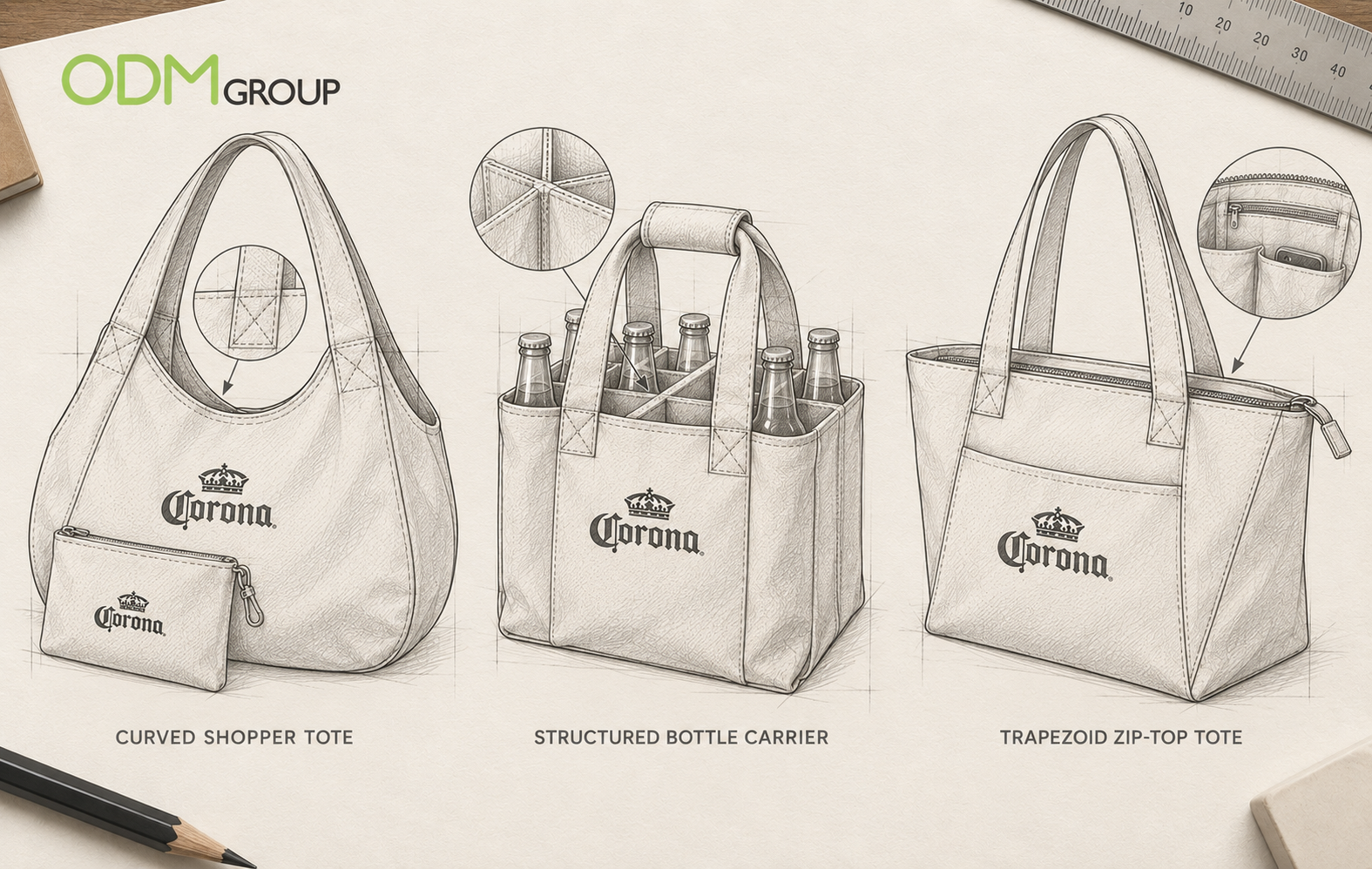
Our design team can develop shapes, features, artwork placement and visual directions around the brand and intended use. Explore our sketch design service.
3. Material and construction planning
We assess fabric, stitching, handles, closures, pockets, branding methods and packaging against the target cost and performance requirements.
4. Sampling and refinement
We coordinate prototyping so the client can review the physical bag before mass production. Feedback may cover proportions, carrying comfort, color, artwork and construction.
5. Production and quality control
ODM supports factory coordination and defines inspection points around the approved sample and specification. Our quality-control services can cover production checks and finished-goods inspection according to the agreed plan.
6. Packaging and delivery coordination
We can also develop custom packaging, retail communication, and delivery planning so the merchandise arrives ready for its campaign.
For a related beverage example, see how another Corona brewery merchandise campaign connected a branded bag with the product and lifestyle positioning.
Turn the Bag into a Complete Campaign
A promotional canvas bag should do more than carry a logo. It should give customers a useful product, support a clear purchase behavior, and express the brand through its materials, form, details, and retail presentation.
Planning a gift-with-purchase, retail, or event campaign? Send ODM your target audience, quantity, destination market, budget range, launch date, and initial idea. Our team can support concept design, material selection, prototyping, factory coordination, quality control, packaging, and delivery planning. Request a detailed quotation.
More Product Ideas


FAQs about Promotional Canvas Bags
What is the minimum order quantity for custom canvas bags?
The minimum order quantity depends on the bag structure, fabric, custom color, branding method and packaging. A standard tote made with available canvas generally supports a lower MOQ than a custom-dyed bag with special pockets, hardware or lining. Share your required quantity with ODM so we can recommend a suitable development route.
How much do custom promotional canvas bags cost?
Pricing is affected by the canvas weight, bag dimensions, handle construction, number of pockets, lining, closures, branding method, packaging and order volume. Shipping and testing requirements can also affect the final cost. A detailed brief is needed for an accurate quotation.
What canvas weight should we choose for a promotional bag?
Lightweight canvas can suit high-volume events and simple giveaways. Medium or heavyweight canvas provides more structure and perceived value for retail campaigns, corporate gifts and lifestyle merchandise. The intended load, appearance, printing method and budget should guide the choice.
Which branding method works best on canvas bags?
Screen printing is suitable for bold artwork and larger quantities. Heat transfer can reproduce more detailed or multicolor graphics. Embroidery, woven labels and patches create a more textured, retail-inspired finish. ODM can prepare samples to confirm how the artwork performs on the selected fabric.
Can the bag include custom pockets, closures or compartments?
Yes. Canvas bags can include bottle pockets, internal organizers, zipped sections, snap closures, key loops, removable pouches and reinforced bases. Each feature affects cost, sampling and production time, so it should support a genuine user need or campaign purpose.
What to Read Next?
Plush Tote Bags That Turn Promotions Into Keepsakes
Promotional bags are everywhere, but few give customers a [...]
Custom Reusable Bags That Keep Your Brand in Motion
A promotion ends at checkout. A useful bag does not. [...]
Custom Eco-Friendly Tote Bags for Retail: Carrefour Case Study
Replacing plastic bags sounds simple until you try to [...]
Woven vs Non-Woven Bags – What is the Difference?
Reusable bags remain one of the most versatile and [...]
Printed Canvas Tote Bags: 5 Ways to Promote Your Brand In Style
Tote bags are popular because they can be used [...]
Custom Design Tote Bags: 7 Easy Ways to Market Your Business!
Bags are arguably the most popular promotional products of [...]